
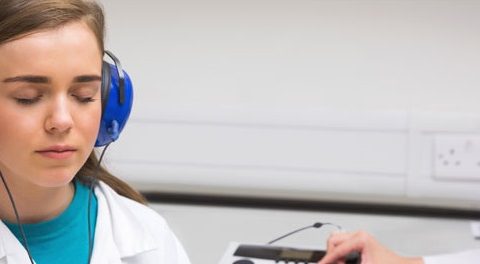
A BERA test in Gurgaon is one of the most trusted ways to find out how well someone hears when they cannot describe it themselves. BERA stands for Brainstem Evoked Response Audiometry, a non-invasive, pain-free test that measures how sound travels from the ear to the brainstem. At Gurgaon ENT Clinic, the difference is that the test is not just performed and handed back as a report. It is interpreted by the same ENT surgeon who can act on the result, so diagnosis and treatment sit under one roof rather than in separate places.
What is a BERA test and how does it work?
BERA does not ask for participation. It observes the auditory pathway directly. Small electrodes are placed on the scalp, usually along the top of the head and on each earlobe, and clicking sounds are delivered through the ears. As the sound travels inward, electrical activity is recorded along the brainstem, producing a series of waves. Those waveforms show whether the auditory pathway is responding normally, and where a problem might lie. Because the test simply listens to the body's own electrical signals, the person being tested does not have to speak, press a button, or react in any way. This is why it is so valuable for infants and young children who cannot cooperate with a standard hearing test.
Who needs a BERA test?
BERA is used whenever ordinary hearing tests cannot give a reliable answer. It helps ENT doctors work out whether a hearing issue lies in the outer ear, the middle ear, the inner ear, or the neural pathway beyond it.
- Newborns who did not clearly pass an OAE screening test
- Babies and children under five, or older children with developmental challenges that prevent cooperation
- Children with delayed speech or who seem not to respond to sound
- Adults with asymmetric or one-sided hearing loss, unexplained tinnitus, or suspected neurological involvement
- Anyone whose symptoms and standard audiometry disagree, where the pathway needs to be checked directly
For a child's hearing, early detection is everything. Many developmental delays can be avoided simply by identifying a hearing problem in time and acting on it.
Is it really surgery, and is it safe?
Despite being commonly called "BERA surgery," this is not a surgical procedure at all. It is a diagnostic test. Nothing is cut, and nothing is implanted. Electrodes are placed on the skin, sounds are played, and responses are recorded. That makes the phrase "BERA surgery" misleading and a common source of unnecessary worry. The test is completely non-invasive and safe, including for newborns, which is exactly why it is the go-to method for assessing hearing in the youngest and most vulnerable patients.
How is a child prepared for the test?
The recording is most reliable when the child is still and relaxed, because movement and muscle activity interfere with the delicate signals. For this reason, babies are usually tested while they are naturally asleep, often after a feed, and older or restless children may be given light sedation so the test can be completed cleanly. Good conditions matter: poor conditions lead to poor data, and poor data can lead to false reassurance or unnecessary alarm. Because the clinic combines audiology, ENT oversight, and anaesthesia support, the test can be carried out safely and accurately in one visit.
BERA compared with other hearing tests
BERA is one of several hearing tests, and each answers a different question. Understanding how they differ explains why a doctor may recommend one over another, or use them together.
| Test | What it does | Best suited to |
|---|---|---|
| OAE (Otoacoustic Emissions) | A quick screen of how the inner ear (cochlea) responds to sound | Newborn screening; a first-line check |
| BERA / ABR | Records the nerve pathway from ear to brainstem; shows where sound is failing | Babies, uncooperative children, and unclear or one-sided adult loss |
| Pure-tone audiometry | Measures hearing thresholds when the person can respond | Older children and adults who can cooperate |
When standard audiometry and symptoms disagree, clinicians look upstream, and BERA helps determine whether sound is failing at the cochlea or along the neural pathway beyond it. In those situations it is not just confirmatory, it is decisive.
What happens after an abnormal BERA result?
A BERA test does not produce a diagnosis on its own. It produces waveforms, and reading them takes experience. When a result is abnormal, the value of testing and treating in one place becomes clear. The findings are discussed together by ENT, audiology, and, where needed, other specialists, mapping what the readings actually suggest, whether the issue lies in the structure of the inner ear or along the nerve pathway. From there a plan follows: monitoring, hearing aids, or, when hearing loss is severe and aids are not enough, an assessment for cochlear implant surgery. BERA is a routine part of the work-up before a cochlear implant, which is why having the surgeon who interprets the test also lead the treatment pathway matters so much. Learn more about cochlear implant surgery and how it can restore hearing after severe loss.
Why choose Dr. Ravinder Gera
Dr. Ravinder Gera is an ENT and Otolaryngology surgeon with 27+ years of experience and more than 18,000 surgeries performed, specialising in cochlear implant surgery and microscopic ear surgery. He is a Gold Medalist, awarded in M.B.B.S. for two consecutive years, and completed MBBS and a Mastery in Surgery in ENT. He is Principal Director and Head of the ENT Department at Max Hospital, Gurgaon, and is a member of the Association of Otolaryngologists of India. From diagnostic BERA testing through to cochlear implant surgery, the clinic offers a single, connected pathway for hearing care in Gurgaon and Delhi NCR, so families are not left carrying a report from one place to another.
What does a BERA test cost in Gurgaon?
A BERA test is a diagnostic recording rather than an operation, so it costs far less than the surgical procedures on this site. Even so, the amount is not the same for every child, because what the test involves changes with the child’s age and how settled they are.
What actually moves the figure:
- Whether sedation or anaesthesia support is needed — a baby tested in natural sleep is a simpler appointment than an older, restless child who needs light sedation with an anaesthetist present.
- How much testing is done — one ear or both, threshold testing versus a screening recording, and whether tests such as OAE, tympanometry or ASSR are added in the same sitting.
- Specialist interpretation — audiologist time during the recording and the ENT review of the waveforms and the report.
- Where it is done — a clinic appointment versus a hospital day-care slot when anaesthesia support is required.
- Repeat or follow-up recordings — sometimes a confirmatory test is needed before a hearing diagnosis is finalised.
On insurance: cover for diagnostic tests depends on your policy and often on whether the test forms part of an admitted treatment plan rather than a standalone outpatient visit. Our team will tell you what is usually claimable and help with the documentation, but please check your own policy wording.
Our published figure: Gurgaon ENT Clinic has not published a price for the BERA test, and we would rather say so plainly than put up a number that turns out to be wrong for your case. An honest figure needs an assessment first, because sedation needs and the tests added alongside it change the appointment. Call +91-9810340495 or book a consultation, and you will be given a written estimate that itemises consultation, diagnostics, the procedure itself and follow-up care.
Frequently asked questions
At what age can a BERA test be done?
A BERA test can be done at any age, including in newborns within the first weeks of life. It is especially valuable for babies and children under five, and for older children with developmental challenges, because it does not need the child to cooperate or respond. In fact, it is the go-to method for children who cannot take part in a standard hearing test, and early testing means any hearing problem can be acted on in time.
Is a BERA test safe for newborns?
Yes. BERA is completely non-invasive and pain-free, which makes it safe for newborns and one of the main reasons it is used for them. Nothing is cut or implanted. Small electrodes rest on the skin, gentle clicking sounds are played, and the brain's responses are recorded. Despite the confusing name "BERA surgery," it is a diagnostic test, not an operation, so there is no surgical risk to a baby.
Does my child need to be asleep or sedated for the test?
The test works best when the child is still, because movement disturbs the delicate signals being recorded. Babies are usually tested while they sleep naturally, often after a feed. Older or restless children may be given light sedation so the recording can be completed accurately in one sitting. Because the clinic combines audiology, ENT, and anaesthesia support, this is arranged safely, and the team will explain exactly how to prepare your child.
How long does a BERA test take?
The test itself is not long, but the appointment allows time to settle the child, place the electrodes, and record clean waveforms from both ears, which is why unhurried, quiet conditions matter. If sedation is used, extra time is set aside for the child to settle beforehand and to recover afterward. Good conditions produce reliable data, so the team prioritises accuracy over speed rather than rushing the recording.
What is the difference between BERA and OAE?
OAE is a quick screening test that checks how the inner ear, the cochlea, responds to sound, and it is often used first for newborn screening. BERA goes further, recording the whole nerve pathway from the ear up to the brainstem, which shows not just whether there is hearing loss but where along the pathway it is happening. A baby who does not clearly pass an OAE screen is often referred for BERA to get a fuller answer.
What happens if the BERA result is abnormal?
An abnormal result is a starting point, not a verdict. BERA produces waveforms that need experienced interpretation, and the findings are reviewed together by ENT and audiology to work out where the problem lies. Depending on the result, the plan may involve monitoring, hearing aids, or an assessment for a cochlear implant when hearing loss is severe. Having the surgeon who reads the test also guide the treatment keeps the whole pathway connected.
Why choose a clinic that both tests and treats hearing loss?
When a test and its treatment sit in the same place, nothing is lost between them. A diagnostic lab can perform a BERA and hand over a report, but it cannot act on it. At Gurgaon ENT Clinic the same ENT surgeon interprets the waveforms and, if needed, leads the next step, whether that is hearing aids or cochlear implant surgery. For families facing a hearing diagnosis, that continuity means faster decisions and one team that knows the whole story.
Explore related information
Learn more through these articles and related services from Gurgaon ENT Clinic: