
There’s a particular kind of tiredness I see in my clinic. It’s not just from a blocked nose or a headache. These are the exhaustions of not finding any solutions despite visiting numerous specialists to breathe freely, which is not achieved. I sat with such patients and all their stories are familiar. Usually, they tell me they’ve already had one sinus surgery, maybe two. The polyps came back, slowly at first, then all at once. And they’re worried this is just their life now.
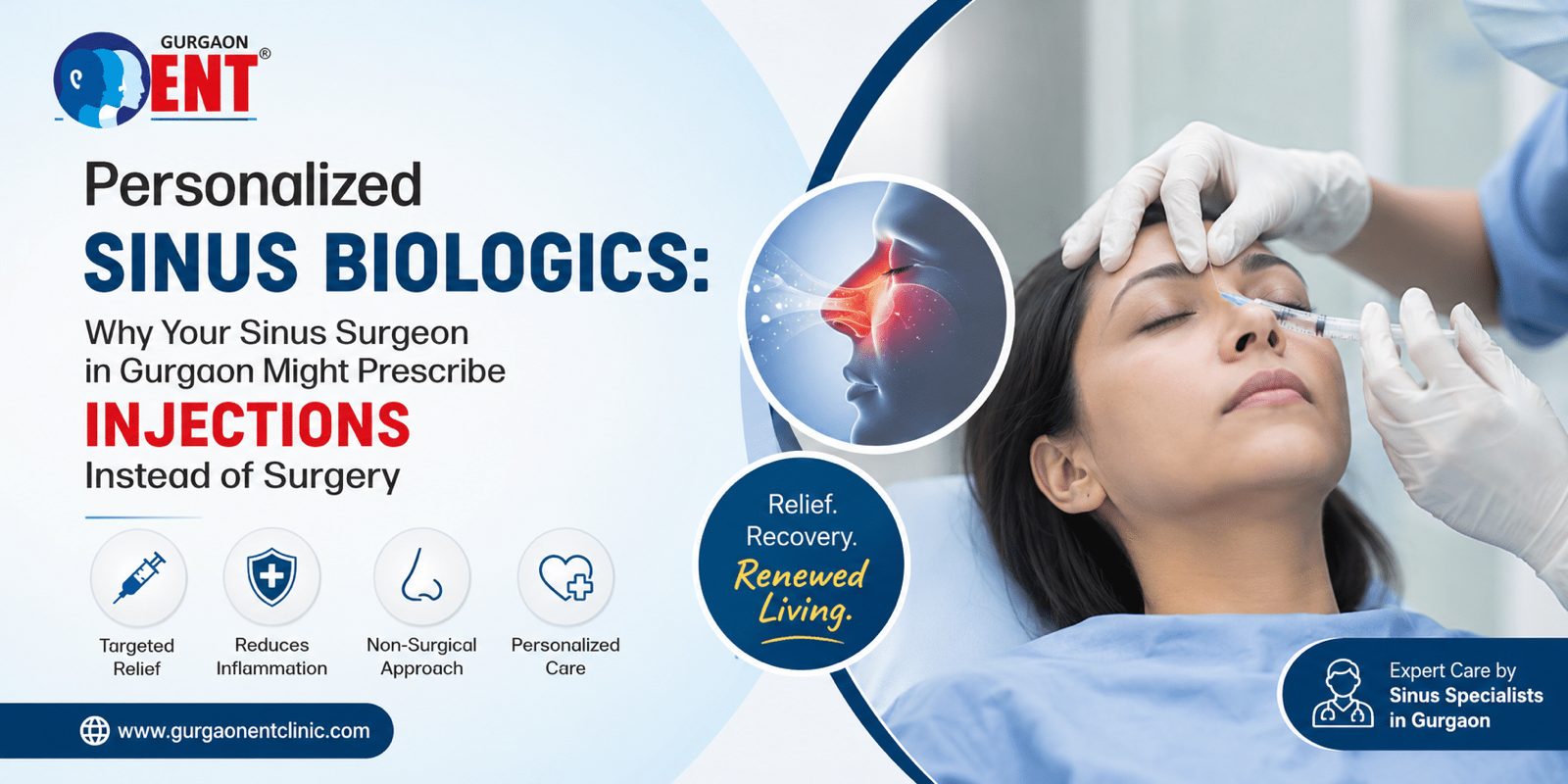
That’s when I sometimes bring up an option that surprises them. Not another operation. Something simpler, in a way. A regular injection. I know, it sounds odd, walk into a surgeon’s office and walk out with a prescription for shots instead of a date for theatre. But I’m a Sinus Surgeon in Gurgaon, and part of my responsibility is knowing when surgery can take a back seat. So let me explain.
Why Some Sinuses Just Never Settle Down
Chronic sinusitis, the kind that sticks around for months and years, isn’t really one disease. In some folks, the immune system overreacts quietly but persistently. There’s a particular flavour of inflammation—type 2, we call it recruits cells called eosinophils into the sinus lining. Those cells cause swelling, polyp growth, and thick mucus that doesn’t drain properly. For many people, nasal sprays, rinses, and a careful endoscopic sinus surgery clear things up nicely. But for others, the underlying inflammatory drive is so strong that polyps regrow before the year is out. It’s not because the surgeon did a poor job. The body simply isn’t listening.
When someone has that kind of relentless polyp regrowth, plus maybe asthma that also flares up, I start thinking differently. Instead of planning a revision surgery right away, I start thinking about biologics.
The Simple Idea Behind Biologics
Biologics sound futuristic, I get that. But really, they’re just targeted proteins that block very specific inflammatory signals. Where a steroid tablet dampens the whole immune system broadly, a biologic might block only interleukin-4 and interleukin-13, or maybe interleukin-5, or IgE. These are tiny messengers that fan the flame in chronic sinusitis with polyps.
The practical part is straightforward. You get a small injection under the skin, much like an insulin shot, usually every two to four weeks. The first few are here at the clinic. After that, many patients learn to do it themselves at home. No needles in the nose. No packing. Just a quick shot, and you go about your day. Honestly, after the first month, most people say it’s become routine.
How a Surgeon Decides, Quietly and Patiently
I never rush to this. My first step is always just listening. I want to know your whole story: when the sinus trouble started, what you’ve tried, how your breathing feels on a good day and a bad one. Then I’ll gently look inside with a tiny nasal camera. It’s not painful, just a bit odd for a moment. That scope shows me the real state of things, the colour of the lining, the size of any polyps, how much clear space there is for air to move. Sometimes I suggest low-dose CT scan and normal blood test to detect the eosinophil count. When the pattern is severe, inflammation and I have been informed that polyp came back from the past surgery, I start connecting them together. This time, the injection option will be advised, to consider a different angle.
Who Might Truly Benefit
I find myself suggesting biologics most often when:
– Nasal polyps have returned aggressively even after a well-done sinus surgery.
– There’s asthma in the background, and both the nose and chest feel out of control.
– The person has needed multiple steroid courses and is starting to worry about the side effects—weight gain, sugar problems, bone thinning. I worry about those too.
– Surgery carries extra risk, maybe because of age or other health conditions. Avoiding anaesthesia can be a genuine gift.
– There’s something called aspirin-exacerbated respiratory disease, where polyps are notoriously stubborn.
Sometimes, I don’t even skip surgery entirely. I’ll do a single, targeted operation to clean out the worst blockage, and then start biologic therapy right after to keep the inflammation quiet. The two approaches aren’t enemies. They can work together.
What Starting This Journey Feels Like
I remember a patient, a 52-year-old gentleman from Gurgaon, who came in last winter. He’d had two sinus surgeries elsewhere, and his polyps were back. He couldn’t smell his own house, his asthma was getting harder to manage, and he looked defeated. His blood eosinophil count was high. We talked for a long while. I could see the idea of regular injections made him nervous. I didn’t push. I just shared what I’d seen in similar cases, the kind of results that were possible, and the commitment involved.
He decided to start. The first dose we gave right here. By the third injection, he noticed something small but profound—he smelled wet earth after a light rain. His wife later told me he stood outside for five minutes just breathing it in. At six months, the endoscopy showed dramatic polyp shrinkage, over 70 percent. He don;t require any surgery, his asthma is better but not cured, he is just living in the other way. Stories like that are why I keep having these conversations.
The Good, and the Real Trade-offs
The benefits can be seen, with lower sinus infections, lesser need of steroids orally, realtime shrinkage of polyp, smell coming back, and the quality of life improves which don;lt involve the nose. Research backs this up. A well established research paper “Journal of Allergy and Clinical Immunology” confirmed that dupilumab like drugs lower the need of more then one surgery and use of steroids for severe nasal polyposis. You can find the article here: (https://pubmed.ncbi.nlm.nih.gov/33202199/ )
But I also have to mention the real-world challenges. These medications are not cheap. In India, insurance coverage is still hit-or-miss, though I help with documentation and patient support programs wherever possible. Side effects are usually mild—some redness at the injection spot, maybe a little itch. Rarely, there can be an allergic reaction. Because biologics tweak part of the immune response, I discuss any specific risks based on your health background.
And it’s a long-term thing. Stop the injections, and over time the inflammation often drifts back. So it’s not a quick fix. It’s a partnership.
Biologics vs. Endoscopic Sinus Surgery: A Comparison
| Aspect | Biologic Therapy (Injection) | Endoscopic Sinus Surgery (ESS) |
| Goal | Control inflammation long-term | Open drainage, remove polyps & diseased tissue |
| Mechanism | Blocks specific cytokines/IgE | Mechanical clearance |
| Onset of benefit | Gradual, over weeks to months | Typically rapid, once healed |
| Repeat procedures | Ongoing injections (every 2–4 weeks) | May require revision if polyps recur |
| Typical candidate | Severe type 2 CRSwNP, recurrent disease | Medically refractory CRS with anatomical blockages |
| Systemic effect | Modulates systemic immune pathways | Local, no systemic immune modulation |
| Commitment | Long-term medical therapy | One-time procedure with possible recurrence |
This is not a competition; the table simply illustrates how these options address different parts of the problem. In a personalized treatment plan, a Sinus Surgeon in Gurgaon might use both, intelligently sequenced.
What We Do Differently at Gurgaon ENT Clinic
I’ve been managing sinus disorders for a good many years, and if there’s one thing I’ve learned, it’s that no two noses tell the same story. At our clinic, we don’t follow a rigid flowchart. We use high-definition scopes, low-dose CT scans, and carefully chosen blood work to understand your specific disease pattern. But more than the tech, it’s the time we spend talking that shapes the plan. Whether that plan ends up involving a biologic, a precise surgery, or a mix of both, my goal is that you leave the room clear on your options and feeling genuinely heard.
If you’d like to read a bit more about how we evaluate sinus issues, you can visit our [sinus treatment page](https://gurgaonentclinic.com/sinus-treatment ) or the section on [diagnostic nasal endoscopy](https://gurgaonentclinic.com/nasal-endoscopy ).
FAQs
Will this cure my sinus problem?
No, it’s not a cure. But it can offer long-term control, much like a daily medication for blood pressure. If you stop, the inflammation may gradually return.
Can I get biologics instead of my first surgery?
Usually, we try adequate medical therapy and at least one surgery first, unless there are special reasons not to. I look at each case individually.
Do the injections hurt much?
Most people tell me it’s like a quick pinch. Considering the breathing improvements, they rarely mind it.
Will my insurance cover it?
Coverage varies a lot. I help with the paperwork. Sometimes pharmaceutical companies have programs that help offset costs. I never hide the financial piece from you.
A Closing Thought
The road with chronic sinusitis can feel lonely and endless. But it doesn’t have to stay that way. A Sinus Surgeon in Gurgaon can now look at your specific inflammatory pattern and suggest a strategy that’s tailored to you, not a generic protocol. Biologics aren’t for everyone, and they come with commitments. But if you’ve been caught in that draining cycle of surgery and recurrence, they represent a genuine option that wasn’t available just a few years ago.
If you’re tired of fighting your own sinuses and want a plan that makes sense for your life—your actual day-to-day reality come talk to us. Let’s look at the whole picture together. You can visit [https://gurgaonentclinic.com/](https://gurgaonentclinic.com/ ) or call the clinic to book an appointment. Breathing shouldn’t be a constant battle.
This blog is intended for general informational purposes only and does not replace professional medical advice. Please consult your ENT surgeon before resuming diving or any pressure-related activity after ear surgery.
Gurgaon ENT Clinic | Website: gurgaonentclinic.com