
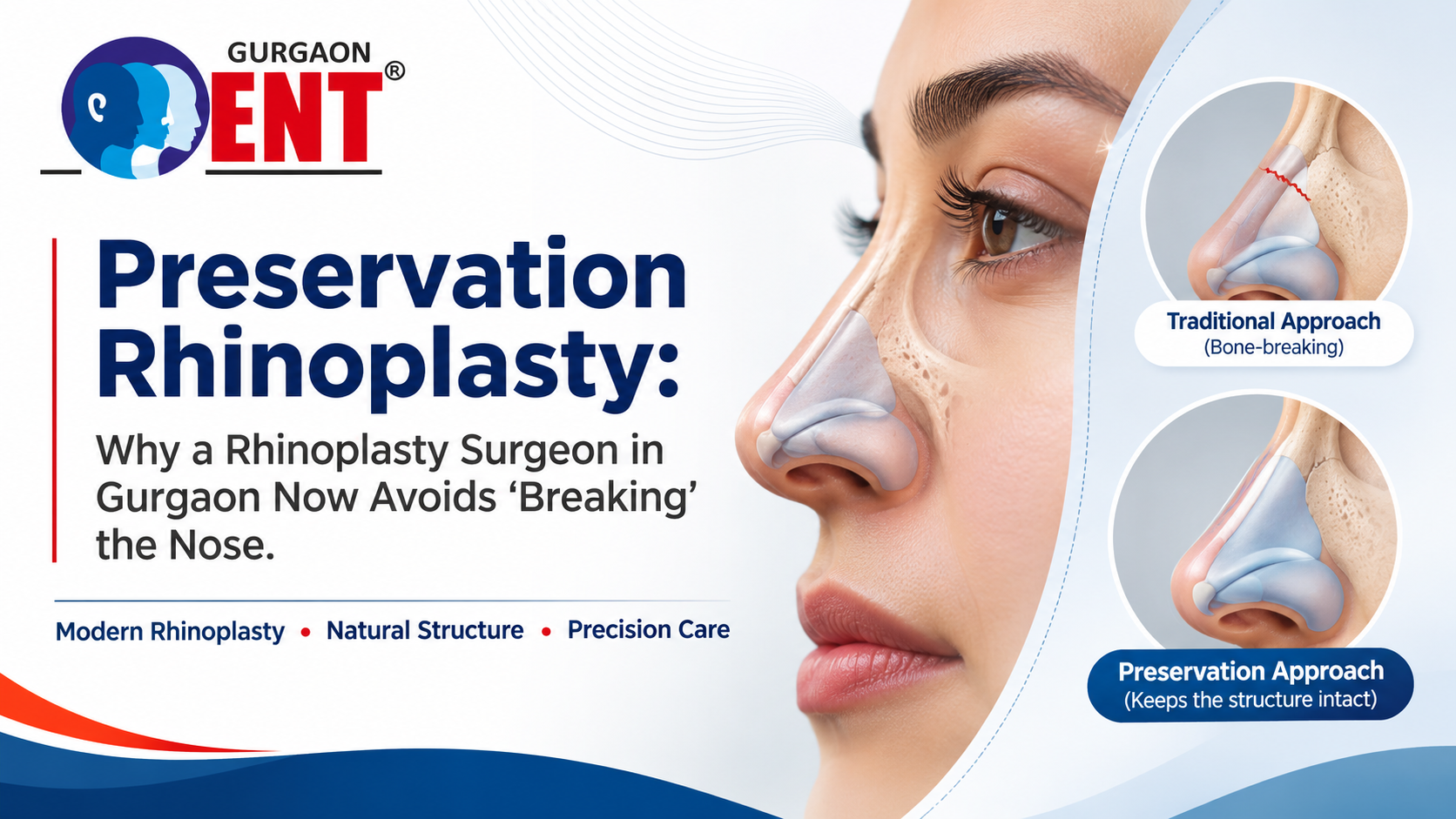
Most people picture the same thing when they hear nose job. The surgeon breaks the nasal bones, takes off the hump, and rebuilds the bridge. It works. But the first few weeks are rough. There is swelling, bruising, and a nose that feels like it has been in a fight.
Now things are differently done by the surgeons. Rhinoplasty preservation keeps the bony ridge intact and moves it in place of removing or rebuilding it. The nose gets refined. It does not get reconstructed. The structures that control breathing mostly stay where they are.
The patients want to have a better look of their nose, not another type of nose. They also go back to their work as soon as they can. A retained rhinoplasty surgeon in Gurgaon can do both , a smoother shape and a very quick recovery.
What Preservation Rhinoplasty Means
This is not one operation. It is a group of techniques with the same idea behind them: leave the natural bridge structure in place where possible. The bone is lowered by moving it, not by cutting it out and rebuilding the middle of the nose.
Two methods are common. The nasal pyramid is taken apart from the top and pushed below in one piece. In this let-down, a small piece of bone is taken so the bridge can be placed low. In both the cases, the area where the keystone is located is not touched. This is the spot where nasal bone connects with the cartilage.
Preserving the keystone as it is , is important. The nose can function in its normal tension. The nasal valves which work for controlling the airflow, have very less chance of affecting. The skin and soft tissues also take less harm from this way, this is the way when the recovery looks different.
A 2026 paper in Plastic and Reconstructive Surgery–Global Open put it simply. Preservation rhinoplasty "shifts the operative philosophy from dorsal reduction to dorsal conservation." It describes what changes in the operating room, not a marketing line.
Why Breaking the Bridge Is Now a Choice
Traditional rhinoplasty is still the right operation for many noses. Bad deviations, structural collapse, and revision cases often need the framework taken apart and rebuilt. But most patients who come in have a smaller problem. A mild bump. A bridge that looks a little wide. A tip that needs definition. Breaking the bones can be more surgery than those noses need.
Fractured nasal bones swell. The swelling can hide the result for weeks. Bruising around the eyes is normal. Sometimes an open roof forms where the bones were narrowed, and the surgeon has to close it. None of this is dangerous. It is just more disruption than necessary for some cases.
The preservation works in the existing anatomy of the nose , and because of this there are very low problems in it. A study in 2026 showed in the same article low swelling in the beginning and earlier definition along the bridge preserving patients if you compare it with structural rhinoplasty. The nose still changes. It just changes with less inflammation around it.
What Recovery Is Actually Like
This is where preservation makes the strongest case.
Because there are fewer cuts in the bone and no major rebuild, the soft tissue is less disturbed. Swelling tends to be milder. Bruising is lighter. Packing is often not needed, and congestion is usually less than after a standard hump reduction.
Most patients are back to light activity in about a week. Desk work is often possible in seven to ten days. No gym or contact sport for at least two weeks. That is a shorter break than the traditional timeline. A 2026 report from a private practice described "faster visible recovery" in preservation patients, along with less early swelling.
There is a psychological side too. When the nose looks like a better version of the original, patients tend to worry less in the first weeks. The swelling goes down slowly and the shape settles without the "done" look that some traditional cases have early on.
Who It Suits and Who It Doesn't
Preservation is not for every nose. Any clinic claiming otherwise is overselling.
The good candidates usually share a set of features. Straight lines down the bridge when viewed from the front. Shorter nasal bones. A V-shaped dorsum. A hump under about 4 mm. Skin thin enough to redrape well. In plain terms, if the front view is already balanced and the profile is the main complaint, preservation is often a good fit.
A 2025 review of 50 hybrid cases listed what makes it less predictable. Uneven or wide lines along the bridge. An S-shaped dorsum. A badly deviated septum. For those noses, a hybrid plan may be safer: preservation on the bridge, structural work on the tip or septum. Using pure preservation on the wrong anatomy can weaken the framework or leave a bump behind.
Selection matters more than enthusiasm. A surgeon should be able to say why preservation fits one nose and not another. The answer comes from the anatomy, not from preference.
Take an example, made up for illustration and not a real patient. A 34-year-old working in Cyber City has a small hump, straight front lines, and no breathing problems. Preservation likely suits that nose. A second patient has a wide, uneven dorsum, a deviated septum, and a blocked nose on one side. That one may need a hybrid or a structural repair. Same city, same request, different anatomy, different operation.
The Trade-Offs
Preservation has limits.
The learning curve is steep. Not every deformity can be fixed without cutting bone. And the research is still catching up with how popular the technique has become.
Functional outcomes were similar to structural rhinoplasty, with improvements in validated patient-reported outcomes in a systematic review and meta-analysis of 22 studies including 2058 patients. This was concluded in another review in 2026. However, the techniques and follow ups vary between studies meaning that the evidence is not as strong.
A meta-analysis published in 2025 showed that preservation was associated with improved short-term aesthetic outcomes and more regular bridges; however, it was also associated with an increased risk of residual/returning hump deformity compared to dorsal reduction. This should not deter you from using this method. A surgeon who knows how to secure the bridge with fixation techniques and ensure the outcome is checked over time will be needed.
Why Gurgaon Patients Ask About It
The patient mix here is particular. Many work in corporate roles, run businesses, or are in front of clients. They cannot take three weeks off. They want a nose that looks better, not different. They want to breathe properly. And they want a surgeon who treats both as part of the job.
At [Gurgaon ENT Clinic (https://gurgaonentclinic.com/ )], a clinic run by Dr. Ravinder Gera, rhinoplasty is just one part of their broader ENT offering. The clinic has 27+ years of experience, has successfully performed 18,000+ ENT procedures and have a range of rhinoplasty procedures available to help treat nasal deformities, breathing problems, trauma, asymmetry and enhance appearance. This is ideal for preserving your nose as it takes into account airflow. A surgeon with ENT training will consider the whole nasal anatomy including your septum, valves and bony structures.
He has a MBBS (with gold medal) and MS in ENT. He has experience with Functional Endoscopic Sinus Surgery, Skull base surgery and Rhinoplasty. This gives patients a range of options from preserving to structural repairs. It means the decision is less influenced by what the technique can do and more about what they need their nose to do.
What to Ask at the Consultation
The consultation can be a nice discussion around the anatomy. Surgeon should be looking at bone, septum, tip support and skin thickness. It is helpful to get imaging, but the physical exam is far more important. A discussion on what can and cannot be preserved, and what a mixed approach will look like if the anatomy sits in between.
Anyone looking for a Rhinoplasty Surgeon in Gurgaonshould go past the basic question of whether they offer preservation. Ask how often they use push-down versus let-down. Ask how they deal with blocking points that stop the bridge from seating properly. Ask how they fix the dorsum to reduce the chance of the hump coming back. Those answers separate a surgeon who has read about the technique from one who uses it.
Preservation vs Traditional Rhinoplasty
Feature | Preservation | Traditional structural |
Bony bridge | Moved, often no fractures | Fractured and rebuilt |
Keystone area | Left intact | Often reconstructed |
Early swelling | Usually milder | Often more |
Bruising | Usually less | Often more visible |
Packing | Often not needed | Sometimes used |
Main specific risk | Hump returns | Open roof, irregularities |
Best for | Selected primary cases with good anatomy | Severe deviation, collapse, revisio |
Use this as a rough guide. The right operation depends on the individual nose.
Frequently Asked Questions
Is preservation rhinoplasty safer than traditional rhinoplasty?
Both have low complication rates when the patient is chosen well. Preservation avoids some fracture-related problems, such as an open roof and heavy soft tissue trauma, but it has its own risk. The main one is a leftover or returning hump, which careful fixation helps prevent.
How soon can I go back to work?
Many patients are back at desk work in seven to ten days. Swelling and bruising are usually mild and packing is often not needed. Keep away from strenuous activity for at least two weeks.
Can it fix a deviated nose?
Sometimes. Significant septal deviation may need a hybrid plan or a structural technique. The decision should come from an examination.
Will my nose look very different?
The aim is refinement. Most patients get a smoother profile and better tip definition while keeping the overall character of the nose. If the goal is a big change, another approach may fit better.
Does it cost more?
It depends on the clinic, the surgeon, and the complexity. Preservation is not automatically more expensive, but it may need specific instruments and experience. A clear quote should come after an in-person assessment.
Conclusion
Moving away from breaking the nose is not a rejection of traditional rhinoplasty. It is a question of when to do less. For the right patient, preservation offers a result that looks like them, breathes like them, and heals on a schedule that fits around work and family.
It does not suit every nose, and the surgeons who use it well say so first. But if you have been told that a fracture is the only way to smooth a bridge or sharpen a profile, a second opinion is reasonable. A Rhinoplasty Surgeon in Gurgaon who works with preservation techniques can tell you whether your anatomy fits. At [Gurgaon ENT Clinic](https://gurgaonentclinic.com/contact/ ), Dr. Ravinder Gera brings close to three decades of ENT surgery to that conversation, with attention to how the nose works as well as how it looks.