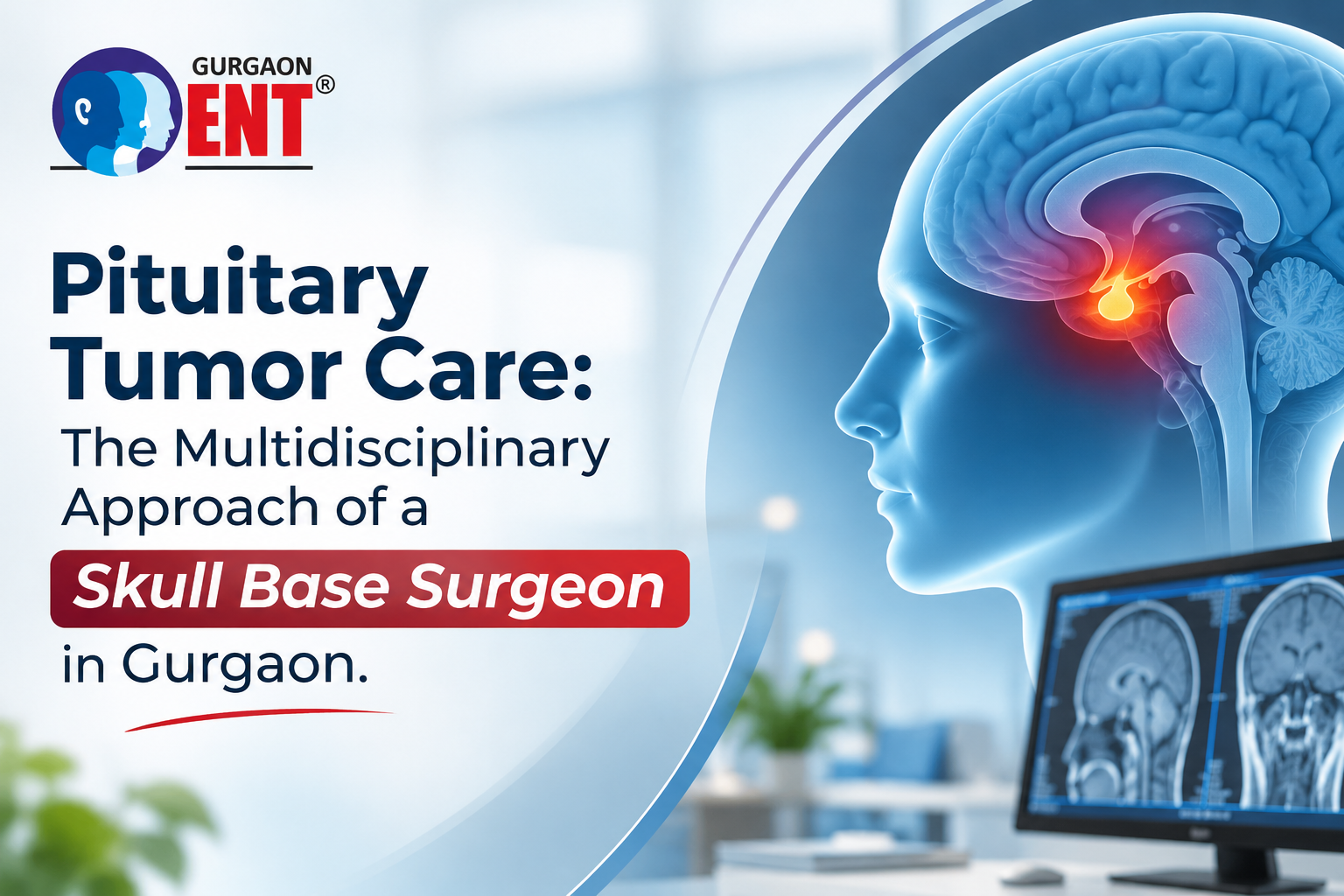
Rarely will a pituitary tumor be just a brain tumor. The pituitary gland is located in the bony “sella turcica” and affects hormone production, vision and delicate areas of the base of the skull. Often patients will present with blurry peripheral vision, unusual tiredness, or hormone symptoms that have been a mystery to identify. As a Skull Base Surgeon in Gurgaon will tell you, a good outcome for a patient does not just rely on one pair of hands, but working as a team to treat the patient not just the scan. Here is a breakdown of how a team will approach your pituitary.
A Pea-Sized Gland With Big Impacts
The pituitary gland is located within the ‘sella turcica’ (bony cup) behind the bridge of the nose. Although it is a small gland it controls thyroid function, adrenal function, growth, reproductive functions and water balance. If a tumor develops it can cause compression upwards to the optic nerves, to the side pushing against the carotid arteries and downwards into the sphenoid sinus.
This can cause a variety of symptoms. Headaches, vision loss (peripheral vision loss that you may not have noticed), irregular period, low sex drive, weight gain and constant tiredness despite sleeping. Many patients can see multiple specialties before an MRI and hormone blood tests are ordered. A team approach is useful here to reduce the amount of time taken to make a diagnosis. Most often a multidisciplinary approach will save money.
What is Multidisciplinary?
This is not just multiple appointments. The Endocrinologist, Skull Base Surgeon, Ophthalmologist, Neuroradiologist and sometimes Radiation Oncologist will review the same case and agree on a single plan. In more busy centres this will happen during a Pituitary Tumor Board. The imaging, hormone reports, and vision reports will be reviewed together.
This is recommended by the Pituitary Society Consensus Guidance. This will help with complex or uncertain lesions within the pituitary gland. Often, what seems like an easy decision based on a single specialty can change once all the details are known.
Skull Base Surgeon
Understanding exactly where the tumor is and what it is affecting. A patient with a non invasive pituitary adenoma will have a different treatment plan compared to someone with invasion of the cavernous sinus and/or compression of the optic nerve. Also, sometimes there are lesions that can mimic a pituitary tumor such as craniopharyngioma, Rathke’s cleft cysts and meningiomas.
If it is safe and appropriate a Skull Base Surgeon in Gurgaon will use an endoscopic endonasal approach. This means the surgical team can access the pituitary without opening the skull or incising the face. Having a high definition view means we can visualize the surrounding critical areas. Whether to operate or not, and how, will depend on a few factors such as hormone test results, imaging, vision, age and patient priorities.
Endocrinologist
Often the first thing will be hormone testing. The Endocrinologist will know if the tumor is functioning (making too much prolactin, growth hormone or cortisol) or non functioning. This will impact the treatment. A prolactinoma may shrink with medication whereas a growth hormone secreting tumor may require surgery followed by medication. Once treated the Endocrinologist will manage the hormone replacement. This often requires patience.
Ophthalmologist
Loss of vision can be a tricky symptom to pick up. Patients may not have noticed their peripheral vision loss until it impacts driving or reading. By performing a formal vision test, we can objectively see what is happening. The Ophthalmologist will get a baseline vision report before treatment. This will help determine how the vision is changing. An important part of pituitary treatment is having a vision report.
Radiology
Not all tumors will require surgery. Sometimes they are small, stable and not producing any hormones. A Neuroradiologist will help us identify if it is really an adenoma or an incidentaloma. The Pituitary Society guidance recommends that often small non functioning microadenomas can be safely observed rather than resected. Having good imaging and an experienced radiologist will reduce unnecessary surgeries.
Surgical
There has been a lot of advancement in endoscopic pituitary surgery in the last two decades. Large/giant tumors can now be removed via the nose with high cure rates and improved vision. However, it is important to consider how well the hormones are controlling, whether vision is stable or improving and getting the patient back to a normal life.
The Skull Base Surgeon works closely with an ENT who will deal with the nasal corridor and skull base reconstruction. This helps keep the nose as functional as possible and reduces the risk of CSF leak. It also reduces any surprises.
Why usually a team approach?
Sharing information with the Endocrinologist, Ophthalmologist and Surgeon will give a more accurate treatment plan. Once treatment has been performed, coordination with the Endocrinologist will mean the hormone replacement can be adjusted quickly and safely. Having the Ophthalmologist regularly assessing vision will mean small changes can be picked up. No single specialty can offer this level of long term follow up.
Having fewer fragmented appointments will make things easier for the patient. There will be one story, one treatment plan. This reduces anxiety and builds trust. Trust is an important part of pituitary treatment.
What should be done
A full assessment should be made. This will involve taking a full history and examination. Usually a range of hormone tests will be performed including prolactin, growth hormone, IGF-1, cortisol and Thyroid function. An MRI of the Pituitary with contrast. If the tumor is large enough to affect the optic pathway a vision test will be performed.
Once this has been done the team should discuss the case. There should be a clear answer to 4 questions. What is the diagnosis? Do they need treatment? If yes, what are the options and risks? If not, what is the monitoring plan? If the clinic cannot give clear answers then ask for a multidisciplinary review. This is not being difficult, it is being sensible.
When would surgery be considered?
Usually a patient will be offered surgery if they are having vision loss, making excess hormones (that cannot be controlled with medication), clear growth or apoplexy (sudden bleed into the tumor). Often an endoscopic endonasal approach will be preferred as there is no retraction of the brain and direct access to the tumor.
However, not all patients will require immediate surgery. Some prolactinomas will respond to medication and some small non-functioning tumors will be stable for years. The skill is knowing when to act. This is why a team review can help.
Recovery
Most patients will go home after 1-2 days following endoscopic pituitary surgery. Patients will return to light activities after 1-2 weeks. Full recovery can take 4-6 weeks depending on surgery and healing. Hormones can fluctuate for months. Diabetes insipidus (excessive urination) can occur temporarily and should be monitored. Vision can improve slowly or become stable.
A shared follow up is important. The Endocrinologist will adjust hormone replacement, the Ophthalmologist will monitor vision and the Surgeon will review the imaging for recurrence. If the patient understands how long their recovery will take they will cope better and ask better questions. Most surgeons appreciate this.
Trust
Ask about the experience of the surgeon, how many cases they have done as a team and how complications are managed. A Skull Base Surgeon in Gurgaon should be able to tell you what can go wrong and how we would manage it. Building trust comes from being transparent. A team approach will make this easier.
A Quick Comparison of Team Roles
Team member | Main role in pituitary care |
Endocrinologist | Diagnoses hormone excess or deficiency, manages medication, and adjusts replacement therapy |
Ophthalmologist | Tests and tracks visual fields before and after treatment |
Neuroradiologist | Reads MRI and helps distinguish true tumors from incidental lesions |
Skull base surgeon | Plans and performs endoscopic surgery when needed, with ENT support |
Radiation oncologist | Plans radiation for residual or recurrent tumor when appropriate |
FAQs
Are all pituitary tumors brain tumors?
No, they are a type of skull base tumor. The pituitary gland is located below the brain.
Can you treat a pituitary tumor without surgery?
Yes, often prolactinomas will respond to medication. Small non functioning tumors can be observed if they are not affecting vision or hormones. This will depend on the type of tumor, size, symptoms and patient preferences.
Why are there so many doctors involved?
The pituitary affects hormone, vision, and skull base anatomy. This cannot be fully assessed by one specialty. Having a coordinated input will fill these gaps and reduce the risk of missing anything.
How long will I be recovering from endoscopic pituitary surgery?
Most patients will be able to do light activities after 1-2 weeks. Full activities after 4-6 weeks. Hormone recovery can take longer.
Conclusion
Pituitary tumor management is a team effort. The gland is very small however it is a big area to consider. Having a Skull Base Surgeon in Gurgaon who is part of a coordinated team can help make a scary diagnosis into a manageable plan. Look for a clinic that have a team that actually communicates with each other. They will be able to explain things in simple terms and the plan will be based around your lifestyle. This is the standard of care all patients should receive and what we provide at Gurgaon ENT Clinic.