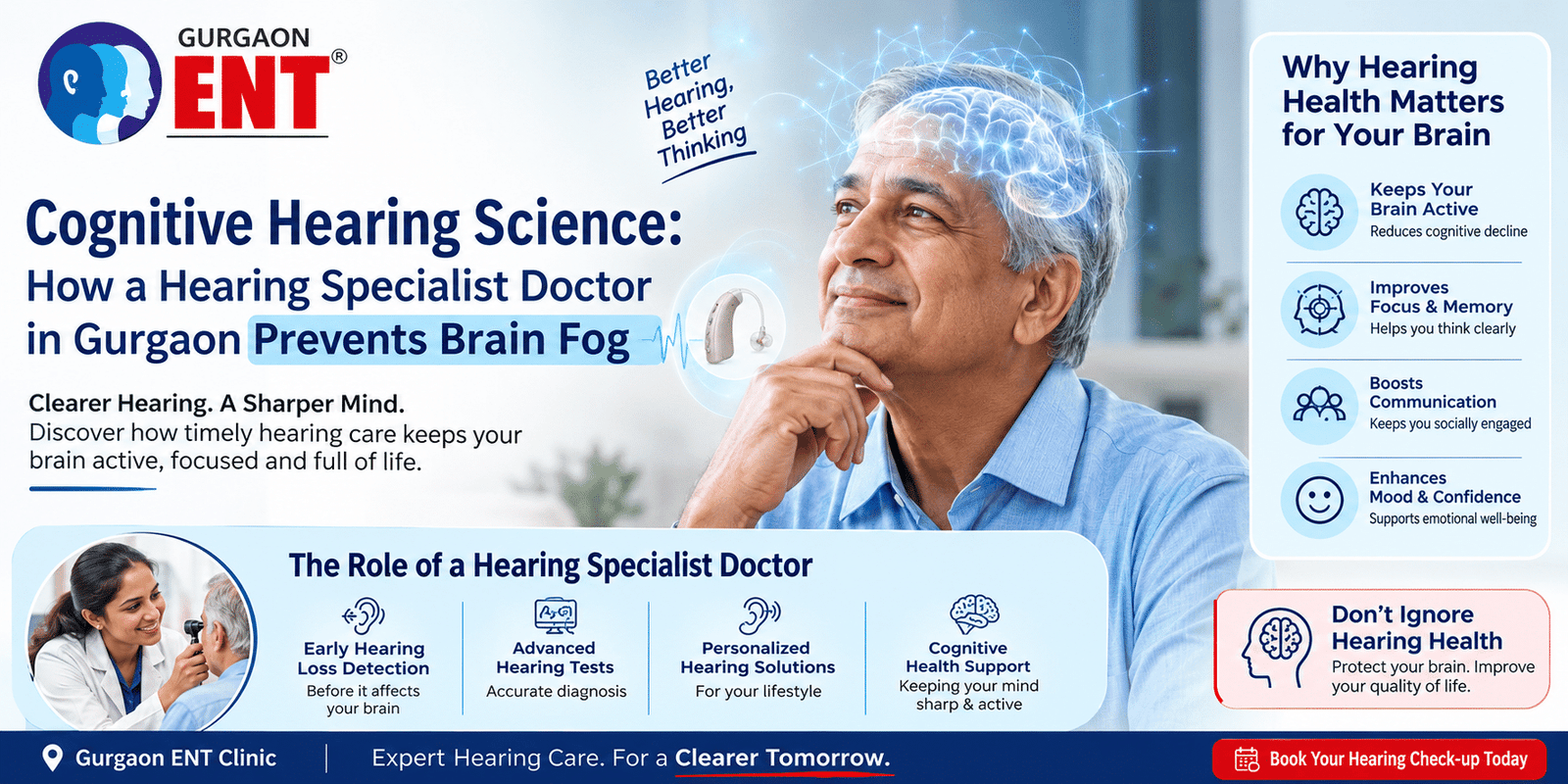
A patient, aged in his mid thirties, visited last year totally sure about his condition, and that is early burnout. He works as a professional with a small team at Udyog Vihar office. He attends 4 to five calls in a day. By the evening, when he went home, he could not have a simple conversation with his kids without telling them to repeat what they were saying. He’d already seen a physician, who found nothing wrong with bloodwork, and a counsellor, who suspected work stress. His hearing test told a different story: a moderate high-frequency loss in both ears, the kind that doesn’t show up as “I can’t hear” so much as “I have to work to follow what people are saying.”
That gap — between how hearing loss actually feels and how people expect it to feel — is the reason this article exists. Most people picture hearing loss as silence. In practice, for a large share of patients we see, it shows up first as fatigue.
This is the subject of cognitive hearing science: how the ear’s mechanical work and the brain’s thinking work are connected, and what happens when one has to compensate for the other. It’s a field every Hearing Specialist Doctor in Gurgaon should be able to explain plainly, because the fog patients describe in the consultation room is, often enough, a hearing problem that hasn’t been named yet.
What Cognitive Hearing Science Actually Looks At
Standard hearing tests answer one question: can you detect a sound at a given volume and pitch? Cognitive hearing science asks a different one — once you’ve detected the sound, how much mental work does it take to turn it into meaning?
The mechanics of hearing haven’t changed: sound waves move the eardrum, three small bones in the middle ear amplify that vibration, hair cells in the cochlea convert it into an electrical signal, and the auditory nerve sends that signal to the brain. What’s changed is the understanding of what the brain does with a signal that arrives incomplete.
A degraded signal doesn’t get politely ignored. The brain fills in missing consonants, separates a specific voice from an air conditioner’s hum or a neighbouring table’s conversation, and does this continuously, without being asked. That work draws on the same regions used for memory, attention, and decision-making — not a separate, dedicated “hearing” processor working in isolation.
Researchers call this the Framework for Understanding Effortful Listening, or FUEL. Under this model, degraded hearing pulls the prefrontal cortex — ordinarily busy holding a to-do list in mind or deciding what to say next — into a job it wasn’t built for: real-time signal repair.
Why Conversations Leave Some People More Drained Than Others
Two patients with nearly identical audiograms can describe completely different days. One says meetings are fine. The other says she’s wiped out by 4 p.m. and can’t explain why. The difference usually comes down to how much of her day involves group conversation, background noise, or unfamiliar accents — situations that force the brain to do more repair work per sentence.
A 2025 review of listening-effort mechanisms found that hearing loss triggers compensatory cognitive strategies, engaging the prefrontal regions and working memory to process degraded auditory signals, with neural adaptations that further raise the mental workload involved. Translated out of research language: a brain spending extra effort decoding speech has less spare capacity to also remember it, connect it to what was said five minutes earlier, or think of a reply.
Audiologists use the term “listening fatigue” for the resulting exhaustion. One clinical summary describes it directly — once the brain has to work harder to process sound, fewer mental resources remain for other cognitive tasks, which is a key reason people with untreated hearing loss often report concentration or memory problems.
This isn’t limited to people with obvious, severe loss. It shows up in mild and moderate cases too, and it shows up hardest in exactly the settings Gurgaon runs on: open-plan offices next to NH-48, loud restaurants for client dinners, weddings with a live band twenty feet from the dinner table.
The Difference Between Hearing and Vision Here
There’s a detail that doesn’t get enough attention: you can close your eyes, but you can’t close your ears. A Frontiers in Aging Neuroscience paper puts it plainly — with hearing loss, the added cognitive and listening effort can raise cognitive load at any time of day, because the auditory system never switches off, and this steadily draws on a person’s ability to compensate. A visual problem gives the brain rest periods. An unaddressed hearing problem generally doesn’t, which is one reason the fatigue tends to build across weeks and months rather than resolve with a good night’s sleep.
Does Hearing Loss Actually Raise Dementia Risk?
This question comes up almost every week, usually from an adult child who’s brought in a parent and is bracing for bad news. It deserves a direct answer, not a reassuring one dressed up as direct.
The concern has real research behind it. A JAMA Neurology meta-analysis covering 31 studies and over 137,000 participants found that hearing loss was consistently associated with an 8 to 17 percent increase in dementia risk depending on severity, with worse hearing corresponding to higher risk. That’s an association, not proof of cause — a distinction worth holding onto, because a lot of coverage of this research drops it.
The strongest evidence for a causal link, so far, comes from a single trial. ACHIEVE followed close to a thousand older adults for three years; its lead investigator called it the first randomised controlled trial to show that treating hearing loss can slow cognitive decline. One trial, three years, one population group — a genuinely important result, and also not the same thing as a settled question.
A separate Johns Hopkins study found hearing aid use associated with a 32 percent lower prevalence of dementia among people with moderate to severe hearing loss. Encouraging, and again, an association drawn from observational data rather than a controlled trial.
Here’s where the field gets honest with itself. A 2026 review in Frontiers in Dementia states that hearing loss from midlife has been identified as the largest potentially modifiable population-attributable risk factor for dementia — a striking claim — but the same review adds that it remains unclear how much hearing interventions can change the trajectory of cognitive decline, and this benefit hasn’t been robustly demonstrated across the evidence base. At least one meta-analysis has found no statistically significant cognitive benefit from hearing aids at all. The research community is not unanimous, and a clinic that tells you otherwise is oversimplifying to make a sale.
What can be said without overreaching: untreated hearing loss is a real, modifiable factor worth addressing, and it very likely affects day-to-day cognitive symptoms — the fog, the fatigue, the mental checking-out — independent of whatever it eventually turns out to mean for dementia risk specifically. You don’t need the dementia question fully settled to have a good reason to get your hearing checked.
What This Looks Like in Gurgaon Specifically
Three patterns turn up often enough in our practice that they’re worth naming individually, not as a marketing rule-of-three but because the underlying cause and the fix differ for each.
A software engineer in his early thirties, six years into daily eight-hour earphone use on the metro and at his desk, comes in because he keeps misreading spoken instructions in stand-up meetings. His audiogram usually shows a notch at 4,000 Hz — the classic signature of prolonged loud-earphone exposure — while his ability to hear in a quiet room tests completely normal, which is exactly why he assumed nothing was wrong.
A mother in her late forties, managing a household and a full-time job, mentions almost in passing that she’s been turning up the TV and that her husband’s started commenting on it. She attributes the evening fog to being “just tired from the day,” and in some cases that’s the whole story — but a hearing test occasionally finds early, treatable loss that’s been quietly adding to that tiredness for a year or two before anyone thought to check.
A retired patient in his late sixties is brought in by his children, who are worried about what looks like memory decline: he’s stopped participating in family conversations, answers “what?” more than he used to, and seems withdrawn at gatherings. In a meaningful number of these cases, the audiogram — not a cognitive test — turns out to be the more useful diagnostic tool, because age-related hearing loss and early cognitive change can look identical from across a dinner table.
How We Work Out Which One It Is
Telling hearing-driven fog apart from a genuine cognitive issue takes more than a conversation across a desk, because from the outside they can present the same way.
At Gurgaon ENT Clinic, a patient presenting with concentration complaints, memory concerns, or unexplained fatigue is usually evaluated through a specific sequence rather than a single test:
Comprehensive audiometry across the full frequency range. Early loss often starts at the high frequencies that carry consonants like “s,” “f,” and “th” — the sounds that make speech intelligible even when a patient can still hear that someone is talking.
Speech-in-noise testing. A patient can pass a quiet-room hearing test cleanly and still struggle badly the moment background noise is introduced. Since almost no real-world listening happens in silence, this test catches a category of loss that standard audiometry misses.
BERA (Brainstem Evoked Response Audiometry) where the picture from standard testing is unclear, or where a more detailed look at how the auditory nerve and brainstem are handling the signal is needed.
A structured history — onset, which environments make it worse, family history, current medications, other health conditions — because fog has more than one possible cause, and hearing is only one candidate among several.
Skipping this sequence has a real cost in both directions: treating fog as a hearing issue when it isn’t wastes months of a patient’s time, and treating it as early dementia when it’s manageable hearing loss puts a family through unnecessary fear.
What Treatment Actually Involves
“Get a hearing aid” isn’t a one-size answer. What gets recommended depends on where the loss sits and how severe it is.
Hearing aids, for mild to moderate loss. Current digital devices don’t apply uniform amplification — they’re programmed against the specific frequency bands where a given patient’s loss is concentrated. That precision is what reduces listening effort in practice, rather than just making everything louder.
Cochlear implants, for severe to profound loss, or for patients getting limited benefit from hearing aids. The implant bypasses the damaged part of the inner ear and stimulates the auditory nerve directly. This is one of Dr. Ravinder Gera’s primary surgical areas, covering both prelingual and postlingual hearing loss.
Microscopic ear surgery, where the cause is structural — chronic infection, a perforated eardrum — and correctable surgically without any device being needed afterward.
Auditory rehabilitation, for patients who’ve lived with untreated loss long enough that the brain needs a period of retraining once clearer sound is restored. This step gets skipped more often than it should, and skipping it is part of why some patients say a new hearing aid “doesn’t feel right” for the first few weeks.
On timing, the Frontiers in Aging Neuroscience review makes a point worth repeating to patients who assume they’ve waited too long: auditory rehabilitation may still help even at later stages of hearing loss, potentially slowing further neural reorganisation, and restoring clearer auditory signals can free cognitive resources for processing rather than effortful listening. Earlier is better. Later is not too late.
Worth a Hearing Test, Not Automatic Alarm
None of the following confirms hearing loss on its own. Together, and especially if they’ve crept in gradually, they’re reason enough to book a test rather than wait another year.
You’re unusually tired after meetings or gatherings that weren’t physically demanding. You ask people to repeat themselves more in groups or restaurants than you did a year or two ago. The TV or phone volume you prefer has crept up in a way others have noticed. One-on-one conversation in a quiet room is fine, but a noisy room is a struggle. Your focus and memory noticeably dip by evening, particularly after a verbally heavy day. Someone close to you has mentioned that you seem distracted or withdrawn in conversation.
Frequently Asked Questions
Can hearing loss really cause brain fog, or is that overstated? It’s supported by research on listening effort and cognitive load, not overstated. A brain spending extra resources decoding unclear sound has fewer resources left for memory and attention — that trade-off is what produces the tired, foggy feeling patients describe.
Is brain fog from hearing loss reversible? Often, yes — particularly if it’s caught early and addressed with hearing aids, cochlear implants, or auditory rehabilitation, since all three reduce the effort spent decoding sound and free up capacity for everything else.
At what age should I get a hearing check if nothing feels wrong yet? No fixed age applies to everyone, but regular earphone use, a noisy work environment, or crossing 50 are all reasons to get a baseline test every couple of years — the same logic as a routine eye exam before you notice a problem.
Do hearing aids guarantee I won’t develop dementia? No, and a clinic that implies otherwise is overselling. The association between treating hearing loss and reduced cognitive decline risk is real and shows up across several major studies, but researchers haven’t settled exactly how much protection it provides, and the results aren’t fully consistent across the literature. What’s well established is that treating hearing loss improves day-to-day cognitive comfort and communication, regardless of the longer-term dementia question.
A relative seems confused sometimes — could that be hearing loss rather than memory decline? Possibly, and this mix-up is common enough to be worth checking properly rather than guessing from the outside. A hearing evaluation alongside a cognitive assessment, ideally with an ENT specialist and a physician comparing notes, is the reliable way to tell the two apart.
A Word From Gurgaon ENT Clinic
We’ve spent enough years treating hearing loss to notice a pattern worth stating plainly: the ear and the brain aren’t separate patients. When the ear struggles quietly, the brain absorbs the cost, and that cost usually shows up first as fatigue, not deafness — which is exactly why it goes unrecognised for so long.
If conversations have started to wear you out more than they used to, or a family member seems more distracted or withdrawn than before, a hearing evaluation is a reasonable, low-cost way to find out whether the cause sits in the ears rather than the mind. It rules a great deal in or out in a single visit.
Gurgaon ENT Clinic, led by Dr. Ravinder Gera, is located at 112, Apna Bazar, Gurudwara Road, Gurgaon, and provides audiological evaluation, hearing aid consultation, and cochlear implant surgery for patients across Delhi NCR. To book a consultation, call +91-9810340495 or visit gurgaonentclinic.com.
This article is for general information and doesn’t replace individual medical advice. Please consult a qualified ENT specialist for diagnosis and treatment specific to your situation.
Recent Post
-
Cognitive Hearing Science: How a Hearing Specialist Doctor in Gurgaon Prevents Brain Fog
August 24, 2026
-
Tinnitus Neuromodulation: When surgery helps the “ringing,” explained by an Ear Surgeon in Gurgaon.
August 20, 2026
-

Athlete-First ENT: How an ENT Surgeon in Gurgaon optimizes breathing for Gurgaon’s marathon runners
August 18, 2026