
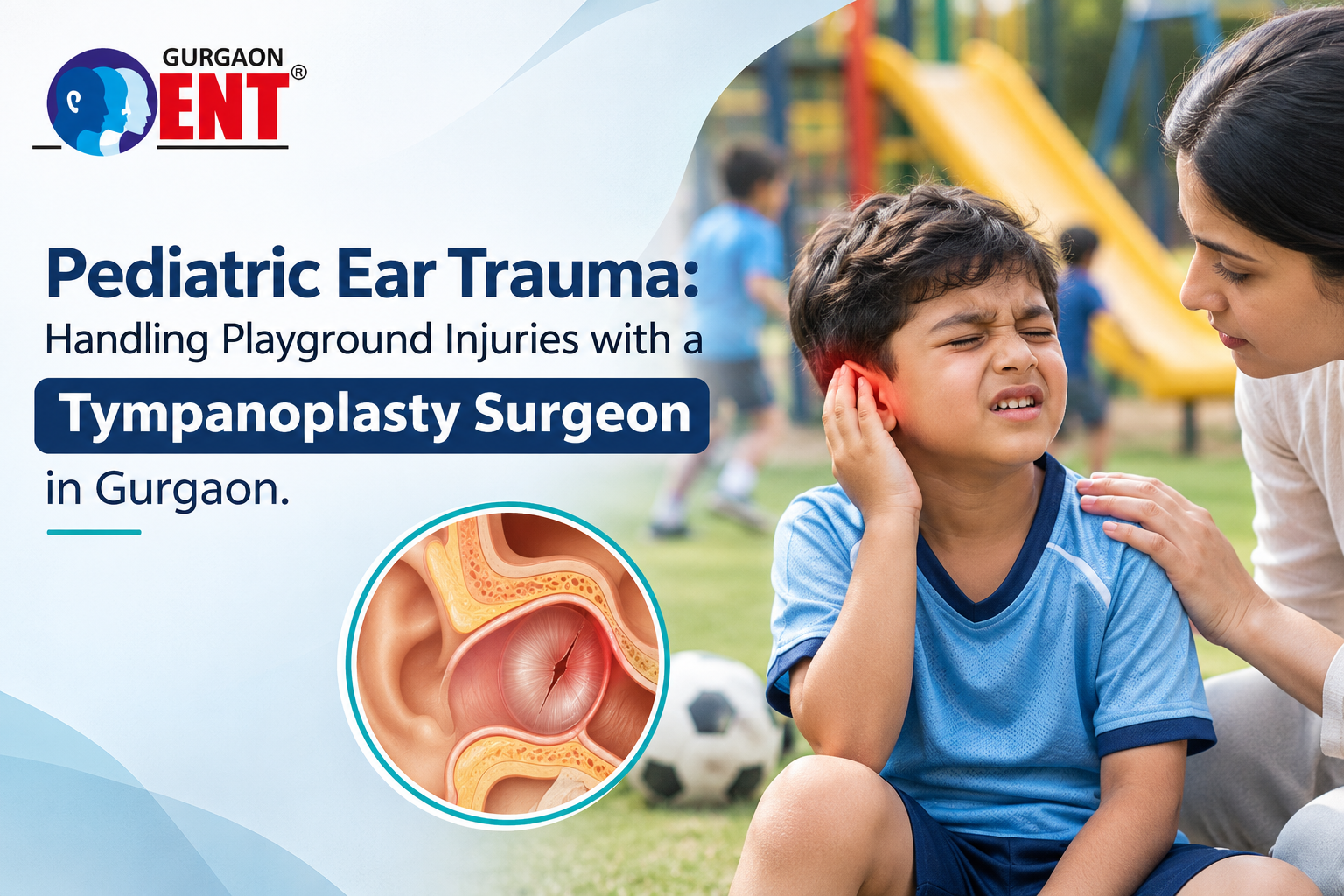
Your child has fallen while playing on the swings. They may have a grazed knee, a bump on the forehead, and be in pain. However, as the ear is not visibly swollen or likely to bleed excessively, many parents do not immediately consider it to be an issue. You may be checking for concussion, applying an ice pack to the knee and offering a chocolate biscuit. However, a traumatic injury to the eardrum may be occurring!
Dr. Ravinder Gera has performed more than 18,000 ENT procedures, with 27 years’ experience as an ENT Surgeon. At Gurgaon ENT Clinic, we regularly see children several weeks after a fall with undetected eardrum perforations.
We have tried to give you concise practical information in a format similar to that given during a consultation with an experienced Tympanoplasty Surgeon in Gurgaon.. As a general rule, while eardrum trauma in children does not require surgery as frequently as many parents may be concerned, it does occur more frequently than many parents may expect.
Why are children’s ears vulnerable?
Between approximately 2-9 years old, children can run faster, jump higher and fall harder. The ears are therefore very vulnerable, as they sit in a vulnerable position on the side of the head. As such, children may injure their ears through impacts from objects, or from falls.
As a result of this, many eardrum perforations secondary to trauma in children are seen in emergency departments from a variety of play/recreation environments. Isolated eardrum perforation is common. References to paediatric eardrum trauma: [PubMed - paediatric tympanic membrane trauma](https://pubmed.ncbi.nlm.nih.gov/?term=pediatric+tympanic+membrane+perforation+trauma ).
Key points from the clinic:
Children with ear trauma will often be able to tell you about the fall. However, it is uncommon for them to give any symptoms relating to the ear. You may therefore not see them for a significant period of time (sometimes weeks, sometimes months) after the incident.
What does a damaged eardrum look like?
The eardrum (tympanic membrane) is a thin membrane. Despite being located within the protected ear canal, it can be torn by direct trauma to the side of the head, falls onto hard surfaces, or insertion of objects into the ear canal (more common that many parents may expect).
In children, symptoms may be very subtle. There may be a little blood, short-lived pain, and a muffled feeling in just one ear. Sometimes however there may be no symptoms at all.
However, a lack of bleeding does not mean that there is no perforation. As the eardrum is quite deep in the ear canal a proper visual inspection using an otoscope is required to determine if there is a perforation. Almost every week, Dr Gera emphasises to parents that we cannot assume based on appearance. It is important to examine the ear.
It is also very important to note that if a child has fallen and is experiencing ear pain, we should not assume this is just a knock to the head. Even small tears in the eardrum can lead to larger problems if infected. Infections in a perforated eardrum may be difficult to treat.
When it may be best to wait
Not all eardrum perforations in children need surgery.
Many small and clean traumatic perforations will repair spontaneously within 4-6 weeks. In this time, it is just important to protect the ear from water and to prevent infection.
The NHS advise to protect the ear from getting water in it. Children should not swim until it has been confirmed by a doctor that it has healed. [NHS - Perforated eardrums](https://www.nhs.uk/conditions/perforated-eardrum/ ).
If it is a small perforation, with clean edges and no sign of infection, it is often best to adopt a ‘watch and wait’ approach. It can be reviewed in a few weeks, and a hearing test may be carried out, depending on concerns. Children will not be rushed in for surgery in this situation. This is not being overly cautious, it is simply good surgical practice.
However, it is a monitored wait. If the perforation has healed, great! If it has not then we can discuss the next steps. Parents will know how things are progressing.
When it may be sensible to go ahead with surgery.
If the eardrum perforation has not healed:
Persistent eardrum perforations mean water and bacteria can enter the middle ear. This can lead to recurrent infections, ongoing discharge, and gradual hearing loss. Without treatment, there is also a greater chance of acquiring cholesteatoma in the middle ear. Cholesteatoma is a more complicated issue in the middle ear, which generally requires surgery to manage.
Surgery should also be considered in large perforations, irregular edges unlikely to heal, significant hearing loss, or recurrent infections. Some children may present with a perforation that has been present for months. Parents may have been given advice that it will heal on its own. Sometimes, it will and sometimes, it won’t.
In this situation, it is usually sensible to refer to a Tympanoplasty Surgeon in Gurgaon.
"Wait Until Ten" myth
Previously, trainee ENT surgeons were often advised to avoid undertaking paediatric tympanoplasty until the child is between 9 and 10 years old. This was based on anatomical factors. The Eustachian tubes in younger children are shorter and more horizontal. Ear canals are also still developing. Older textbooks state that earlier tympanoplasties are more likely to fail.
Many ENT surgeons of Dr Gera’s generation were trained with this in mind. However, as evidence has changed, so have Dr Gera’s opinions.
Within recent paediatric series, high success rates have been noted for grafts in younger children. Several reviews suggest that it may be sensible to proceed with surgery according to the clinical situation, rather than age. References to paediatric tympanoplasty and age related outcomes: [PubMed - paediatric tympanoplasty and age related outcome](https://pubmed.ncbi.nlm.nih.gov/?term=pediatric+tympanoplasty+age ).
At Gurgaon ENT Clinic, we do not adopt a strict age cut off. We take a holistic approach to determining whether to perform surgery. We take into account the extent of the perforation, function of the Eustachian tubes, and status of the adenoids, nasal airways and infection history. If we feel it is safer to repair, we say so. If we feel it makes more sense to wait, we say so. We do not simply give advice based on an outdated rule from 40 years ago.
What does tympanoplasty involve in children?
Tympanoplasty is surgery to repair the eardrum. Generally a small amount of autologous tissue (cartilage/fascia) is taken and used to seal the perforation. In children, endoscopic and microscopic methods are favourable for repairing the eardrum. These methods allow greater precision while minimally disrupting surrounding tissue. Resulting in less scarring, less post-op discomfort, and a smoother recovery (generally) for both the child and parent.
General anaesthetic is generally used in young children. Most children will be discharged the same day (or shortly after). After surgery, it is important to avoid getting water in the ear. This means avoiding swimming and washing hair without protection. The child should not be submerged in water until the surgeon confirms that the graft is secure.
Pain is generally mild. Most children can be given simple pain relief. If a child experiences persistent or increasing pain, this should be reported, although this is rare.
The biggest surprise for parents is often how quickly children recover. Adults often take longer to relax!
What is considered before recommending surgery
Below is a summary of situations and recommendations typically considered.
Situation | What is usually advised |
Small, clean tear, recent injury | Wait 4–6 weeks, keep ear dry, re-examine |
Hole still present after 6 weeks | Hearing test and surgical opinion |
Repeated infections or discharge | Earlier surgical assessment |
Large or irregular perforation | Repair is often considered sooner |
Significant hearing loss | Full workup, then decide |
Child under 6 with persistent hole | Individual assessment, not automatic delay |
Note: Many parents will have seen information suggesting that surgery should be delayed in children. Whilst this is sometimes appropriate, it is not always. To know for certain, it must be assessed.
Why experience is important in Paediatric Ear Surgery
Eardrums in children differ from adults. Canals are narrower, tissues are more delicate, and Eustachian tubes behave differently. There is less room for error in Paediatric Ear Surgery, as hearing is so important for speech development, learning in school, and confidence in social situations.
When seeking a Tympanoplasty Surgeon in Gurgaon, it is important to ensure they have experience in deciding when to operate in children. It is important that they can provide clear advice to a parent who is worried and tired. They must be able to explain why surgery may or may not be appropriate in a simple manner.
Dr Gera holds himself to this very high standard. Having performed over 18,000 ENT procedures over 27 years, he has performed simple and complex revisions in children. Gurgaon ENT Clinic allows for full investigations to take place in one place, including hearing tests. Therefore decisions can be made based on a complete picture.
What to do after an ear injury
Do not put anything into the ear. This could include cotton buds, oils and drops. If there is a perforation, putting these in may cause infection and further damage.
Avoid getting water in the ear. Place cotton wool covered in petroleum jelly in the opening of the ear canal during bath time. Remove after. Do not swim until cleared by a Doctor.
Be aware of red flags. If your child has persistent pain, discharge, fever, dizziness, or noticeable hearing difficulties in the days following the injury, an urgent ENT review should be made.
Obtain a proper assessment. Performing an otoscopy and hearing test (if required) will give a definite answer. It is not helpful to make assumptions.
Do not leave it too long. For clean traumatic perforations, waiting 6 weeks is acceptable. After this time, it is wise to seek a surgical opinion. A perforation that has been in place for months is very different to one in place for 2 weeks.
Frequently asked questions
Can a child’s eardrum heal itself after an injury sustained in a playground?
Yes. If it is a small and clean traumatic perforation, it may heal within 4-6 weeks, providing the ear is kept dry and there is no infection. It is important that it is assessed and followed up.
At what age can children have tympanoplasty?
There is no specific age. Based on current evidence it is best to individually decide based on perforation size, Eustachian tube function and infection history. Tympanoplasty has been successfully performed in children under 6. The decision should be made by an experienced paediatric ENT surgeon who has examined the child.
How long will it take my child to recover from tympanoplasty?
Most children will be able to undertake quiet normal activities within a few days. Water should be avoided until the graft is known to be stable (often a few weeks). Follow-ups will be performed to check that it is healing well and how the hearing is.
Will my child’s hearing return to normal?
In most cases, hearing should improve after repair of the eardrum. How much improvement depends on the anatomy of the middle ear prior to surgery. Getting a pre-operative hearing test can give realistic expectations. It is much better to know how it may be affected in advance.
Will it hurt?
Most children will have mild discomfort. Simple painkillers are generally sufficient. If persistent or worsening pain occurs this should be reported.
Summary
Although traumatic eardrum perforation in children can be concerning, many small traumatic perforations will heal with time. If they do not, tympanoplasty is a reliable option to restore the eardrum, protect the middle ear and preserve hearing in a critical time of development.
At Gurgaon ENT Clinic, Dr Gera prides himself on making decisions in a patient centred way, having performed ENT surgery for 27 years. If you are unsure of what to do following an ear injury in a child, consulting an experienced Tympanoplasty Surgeon in Gurgaon can give you clarity, a correct diagnosis, and a plan centred around preserving your child’s hearing.