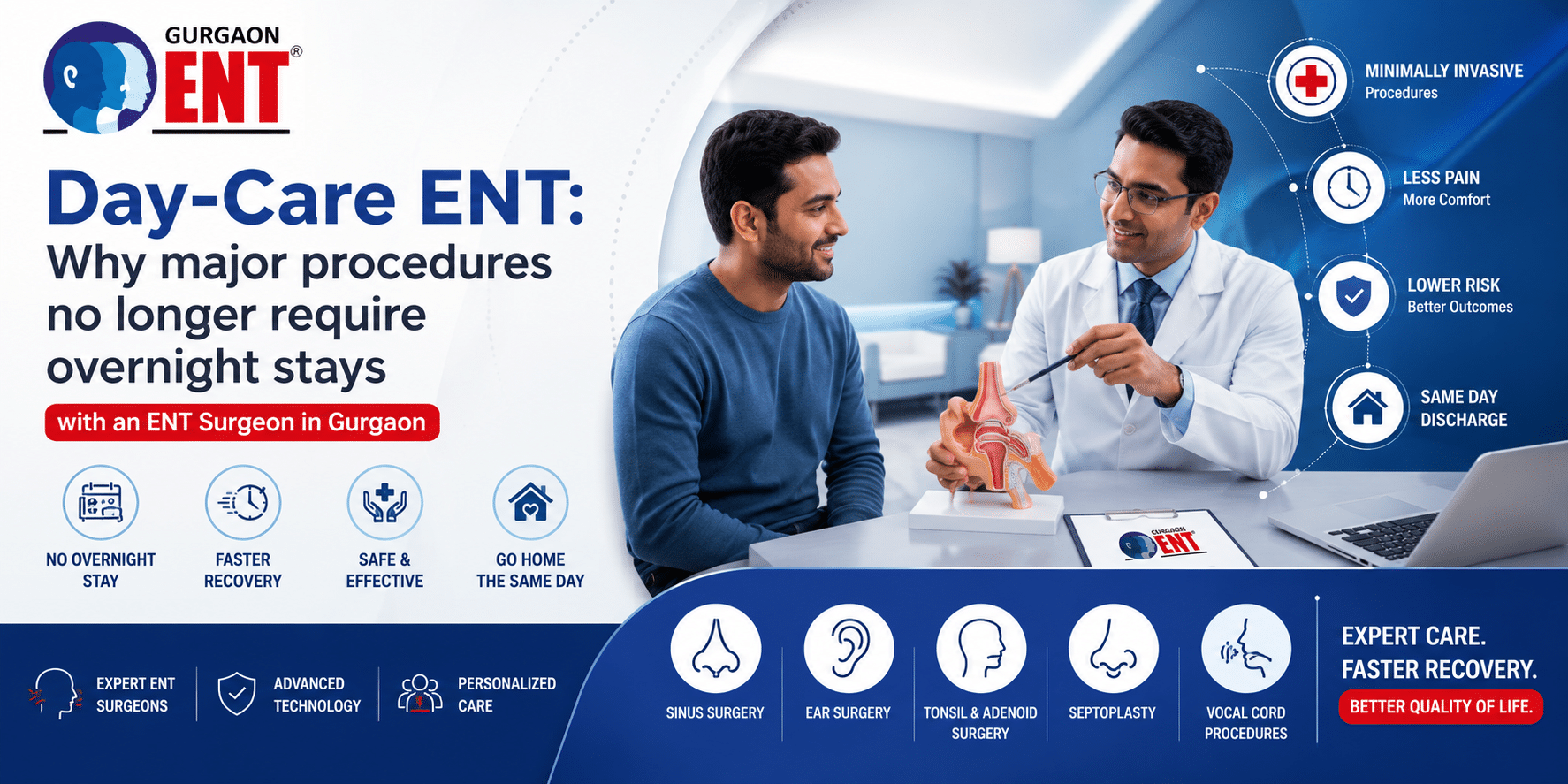
You know those small moments that just stick in your head for no real reason? I’ve got one from last winter. It was chilly outside, the kind of Delhi-Gurgaon cold that bites a little. A young father, maybe early thirties, came into my room. He looked like he hadn’t slept well in years. He told me he’d been breathing only through one nostril—left one, I think—and that sleep had become a total mess. I put the little scope in, had a look, and told him a septoplasty would sort him out nicely.
And before I could even lean back in my chair, the man had his phone out. He was scrolling through his calendar, mumbling to himself, counting days. Sick leave, arrange a babysitter for the little one, pack a bag, get his mother to come over—he had the entire week mapped out. I had to actually wave my hand a bit to get him to stop. I said, look, the surgery will take maybe forty, forty-five minutes. You’ll be home having lunch. He laughed. Not just a polite smile, a proper laugh, like I’d told him something genuinely ridiculous. I had to repeat it twice more. Only then he sat back and just stared at me. That look of disbelief, that’s what day-care ENT surgery has become now. It feels almost too good to be true, but it’s just our ordinary Tuesday now.
I’ve spent a little over twenty-five years as an ENT Surgeon in Gurgaon, and the shift still gets me sometimes. Back when I started, a tonsillectomy meant a night in hospital, always. Sinus surgery meant a puffy face and a guaranteed bed. Now the whole thing, start to finish, is often done in a single morning. Patients walk out a bit wobbly, sure, but by evening they’re propped up on their own sofa, maybe with a cup of soup, and they’re not in a hospital gown. That matters more than anyone can measure.
So what actually changed, then?
I keep thinking about this and it comes down to two things. Not ten complicated ones. Two.
The first is how we get to the problem. We don’t need big cuts. For sinuses, we use these slim, rigid scopes that go in through your nose. The image quality now, I can’t even describe how clear it is. I see the whole landscape there. I can take out exactly what’s causing trouble—polyps, thickened tissue, whatever it is and leave everything else completely alone.
The less you disturb your body, less the body will react. It means that the body will pain less after waking up, bleeding will be reduced, and the recovery will feel like a normal cold than a surgery.
The second is anaesthesia. What we used in the past will be with the system like an unwanted guest. The patient will feel drowsy and sick and can not keep water to himself for hours.
Now? The drugs clear out so fast it almost surprises me sometimes. Just last month, a woman in her forties had a sinus procedure, and within forty minutes of the end she was asking for chai. Proper tea, with milk and sugar. She was a little sleepy, but fully aware, making small talk about the traffic on Sohna Road. That quick return to yourself, that’s the whole secret. If you’re that awake, you don’t need a nurse watching you all night. It’s as straightforward as that.
Surgeries that sound bigger than they are, now
I find that once patients hear the list, their shoulders drop. I mean literally drop. Let me just rattle off a few, the way I do in the clinic.
Take tonsillectomy. Everyone remembers a cousin or a friend who had it done years ago and was miserable for a week. I get it. But we don’t do it the old way anymore. Coblation uses low temperature to sort of melt the tonsil tissue away, and the soreness afterwards is so much more manageable. Whether it is an adult or a child, the recovery of the patient is within hours. We make sure that the patient can drink water, or eat something soft. Once that’s fine, home they go. I’ve had kids eating soft khichdi the next afternoon, not a week later. That’s not a small difference, that’s life-changing for a family.
Septoplasty. Used to mean nasal packing, a bruised look, a groggy night. Now I don’t even pack the nose most of the time. No cuts on the outside, nothing. Just this past Wednesday, I did one for a college girl. She came in at 7:30, we were done by 9, she was out by noon. On Friday she messaged the clinic saying she could smell the petrichor from the rain that evening. That, right there, makes my week.
Sinus surgery—FESS, as we call it—used to require a hospital stay. Now it’s a delicate endoscopic job, clearing out blockage, preserving normal stuff. Home in a few hours. Tiny ear things like putting a grommet in a child’s eardrum take about ten minutes of actual operating. Voice box procedures through the mouth, no scar, same day. The list really has grown longer than most people imagine.
Mayo Clinic has a page on tonsillectomy that mentions it’s regularly done as an outpatient when risk factors aren’t there, and that’s exactly our experience here. (Source: [Mayo Clinic – Tonsillectomy](https://www.mayoclinic.org/tests-procedures/tonsillectomy/about/pac-20395197))
The thing about sleeping in your own bed
Money saved is part of it, obviously. No room charges, no extra nursing, no meal bills stacking up. But honestly, the bigger part is something I can’t put on a receipt. A hospital room is never properly restful. Somebody always comes in to check your blood pressure, the air has that sharp antiseptic smell, and the pillow makes that crinkly noise. At home, your bed knows your shape. The sounds outside are the sounds you’re used to—maybe a dog barking a few lanes down, the creak of your own ceiling fan. Your body, it just lets go in a way it never will in a strange room.
I once had a mother tell me after her eight-year-old’s adenoid removal that the hardest part for her son wasn’t even the surgery. It was the terror of spending a night without her. He had cried all night before, just dreading it. When I said he’d be home by evening, he gave me the most enthusiastic high-five I’ve ever received. That little boy’s relief—I can still see it. Those are the moments you don’t forget.
AN uncanny feeling will be there with older patients when they are into unfamiliar rooms. Getting them back to their own space, their own kitchen sounds, keeps them calm and steady. Anyone who’s tried to sleep in a ward with a beeping machine next to them knows what I’m talking about. Recovery at home just flows better. Fewer hurdles, more quiet.
Our way of doing things, step by careful step
I’m quite particular about this. Day-care surgery is never, ever about hurrying someone out because the bed is needed. At our place, it’s a calm process. It starts with a proper sit-down talk. We go over your history, your medicines, anything that might react with anaesthesia. I answer every single question, even the ones that start with “this might sound silly, but…” because honestly, there’s no such thing. A calm mind walks into theatre differently. I’ve seen it for decades. That peace carries into recovery.
On the day, you come in about an hour early. The nurses settle you in, do the vitals, run the checklist once more. The theatre is properly set up, endoscopic towers, laser, microdebrider, coblation. The anaesthetist is someone who works with short-acting drugs every day and really knows them. After the surgery, you’re in recovery. We watch you closely, not just glance and sign. Pain level, alertness, blood pressure. You get water first, maybe a bit of banana if you feel up to it. I come and do a final check myself. Then you go home with a printed sheet that spells everything out—what to eat, when to take medicine, what’s normal and what’s not, and a direct number. A number that actually rings at the clinic. A follow-up is booked within a week, no matter what. And if something feels strange at nine in the evening, you ring us. We answer. That’s a promise I don’t take lightly.
Sometimes, an overnight stay still makes sense
I’d be doing a disservice if I didn’t mention that some folks are better off staying the night. If you have uncontrolled sugar, heart trouble that’s not optimised, a bleeding tendency, or really bad sleep apnoea, I might gently suggest we keep you a little longer. Very young toddlers sometimes need extra observation too, just for everyone’s peace of mind. But these decisions, we never make them alone. We sit with you, maybe with your family, and talk it through. No hidden agenda. Just what feels safest. It’s always a conversation.
Faqs!
Is it really, properly safe to leave a few hours after a surgery?
This one, I get constantly. And I mean constantly. The answer is yes, but only because we are careful about who we pick and what we do, and because we have a system that doesn’t allow guesswork. Nobody leaves this clinic until they’re fully awake, can drink, can walk without wobbling, and their pain is under control. The global evidence shows that outcomes for these day-care procedures are just as good as if you’d stayed the night, sometimes even better because you avoid hospital bugs. I’ve done thousands of these. Rushing a discharge is the last thing on my mind. I’d rather keep you an extra forty-five minutes than send you home a minute too soon.
How much pain are we talking about?
You won’t feel anything during the surgery, you’re completely under. Later, some discomfort may arise. It may feel like a sore throat after tonsillectomy. After sinus work, it’s more like a stuffy head with a bit of pressure. We give you pain relief through the IV before you even open your eyes, and then you continue with tablets at home. Almost everyone tells me it’s very manageable. The trick is to take the medicine on a fixed schedule and not wait for it to hurt badly. Stay ahead of it, and it’s really not a big ordeal.
When can I get back to my normal stuff? Office, driving, exercise?
If you have a desk job, many people go back in two to four days after something like a septoplasty or sinus surgery. If you do physical work, give it a week, maybe ten days. Driving? I say wait at least two days. Even though you feel clear, the anaesthesia can leave a faint haze you don’t notice until you need a quick reaction. The gym and heavy lifting—hold off for a week or two, just until the risk of any oozing is past. We’ll give you a clear timeline that fits your specific situation.
Kids can really go home the same day after having their tonsils out?
Yes, they can recover faster than adults. The pain is low with coblation, so a child can be drinking water and eat small portion of icecream after few hours
We observe them carefully, make sure everything is settled, and then they go home with parents who’ve been given very clear instructions and a phone number. I’ve found that children rest so much better in their own room, with their own toys, their own blanket. They’re less scared, and that speeds up healing in ways we can’t always measure.
What if I get home and something doesn’t feel right later that evening?
You will not be left guessing. The discharge sheet has a number on it, very clearly, and that number rings at the clinic. After hours, it forwards to someone who can help. I tell every patient: if anything worries you, you call. Don’t lie there trying to convince yourself it’s probably nothing. We’d much rather you called and were told everything is fine. Real problems are rare, but knowing you have that direct line to your surgeon that’s what lets people sleep.
If you’ve been holding off, maybe this is the sign
Every week, I see people who’ve been putting up with a half-blocked nose, sinus headaches that come around like clockwork, ear trouble that won’t quit, or snoring that’s driven their spouse into the spare room. They’ve been waiting, not because they don’t care, but because the old picture of a long hospital disruption still sits in their head. I understand that. It’s hard to shake an old image.
But maybe knowing that so many of these things now fit into a single morning makes the weight a little lighter. It’s a conversation that’s worth having, even if you’re just curious at this stage.
If you’d like to sit and talk no rush, no hard sell with an ENT Surgeon in Gurgaon who’s been around the block a few times, you’re very welcome. Just ring the clinic or visit [https://gurgaonentclinic.com/](https://gurgaonentclinic.com/). We’ll listen properly, answer everything in plain words, and help you work out what feels right for your life. Your health doesn’t need to go on the back burner, and getting better doesn’t have to turn your whole routine upside down. Quite often, all it needs is a morning, a bit of courage, and a hot cup of tea when you get home.
Written by: Gurgaon ENT Clinic Team
Gurgaon ENT Clinic, spearheaded by Dr Ravinder Gera, with 22+ years of experience and 300+ ENT surgeries is revolutionizing the ENT treatment in Gurgaon since 2004.
Published:
*Disclaimer: This article is just for information. It can’t replace a proper one-on-one consultation. Every treatment decision needs a thorough clinical check-up first.
Recent Post
-

Globus Sensation: Understanding the “Lump in Throat” Feeling With an ENT Specialist in Gurgaon
September 7, 2026
-

Cognitive Hearing Science: How a Hearing Specialist Doctor in Gurgaon Prevents Brain Fog
August 24, 2026
-
Tinnitus Neuromodulation: When surgery helps the “ringing,” explained by an Ear Surgeon in Gurgaon.
August 20, 2026