
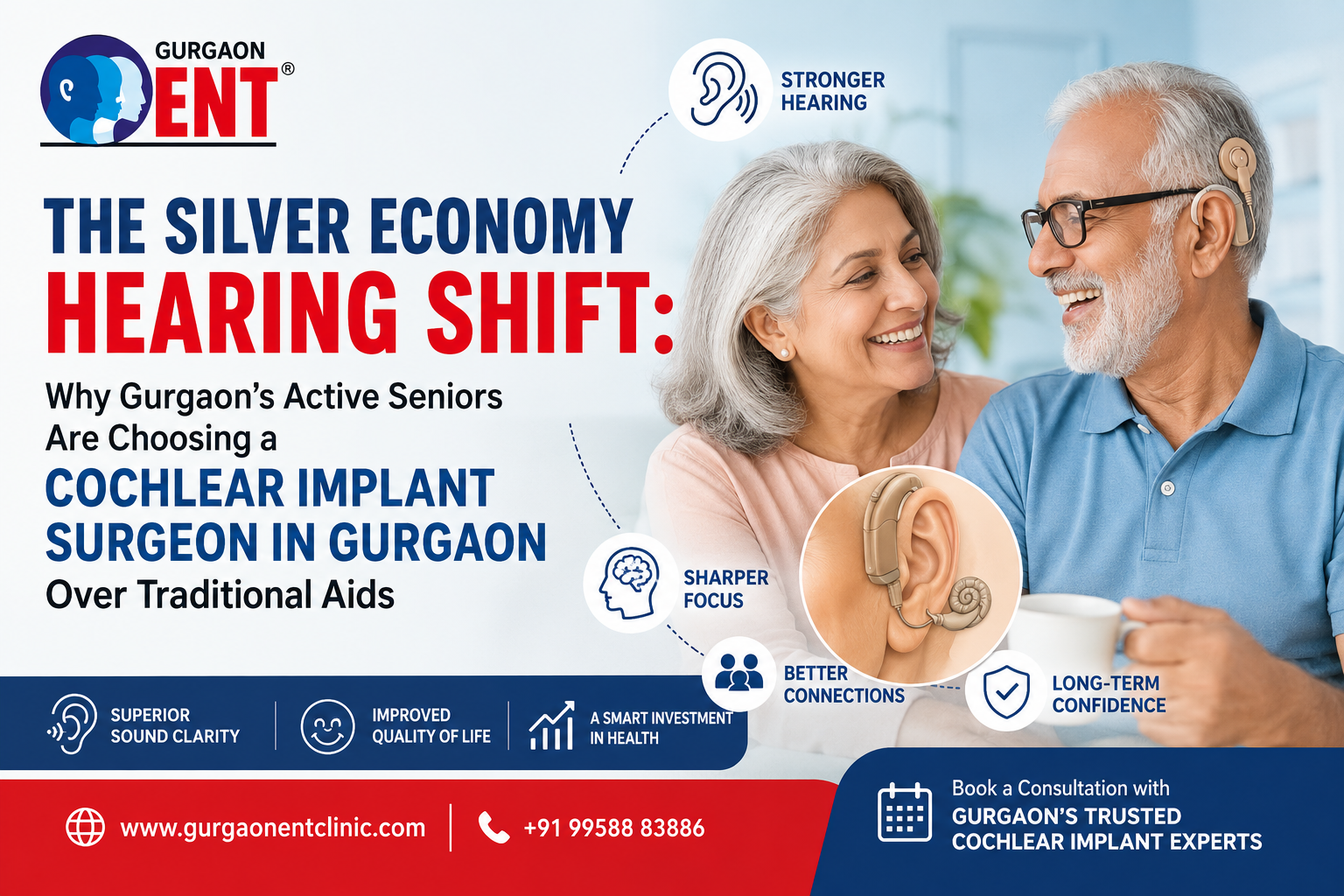
The “Silver Economy” Hearing Shift: Why Gurgaon’s active seniors are choosing a Cochlear Implant Surgeon in Gurgaon over traditional aids.
Gurgaon is noisy. Actually, that’s putting it mildly.The relentless sounds like working in the next block, autos honking relentlessly, music as loud as all can hear from the next house at 7 AM. So it’s normal when a senior citizen comes in and complains about hearing loss.
What shocks me? The resignation. The quiet acceptance that this is just “how it is now.”
I saw a patient last Tuesday. Ex-CFO of a big firm, lives in DLF Phase 3. Walked in with his wife. He had a pouch full of hearing aids, top-of-the-line stuff, the kind that costs more than a used Swift. He could hear the fan in my clinic just fine. But when the wife whispers into his ears , if he is feeling the vertigo? The answer came as , he doesn’t want any tea. She looked at me. I looked at her. He missed the entire thing. The worry, the question, everything. Just white noise.
This is the trap, you see. Hearing aids are amplifiers. They turn up the volume on *everything*. The rustle of paper, the hum of the AC, the traffic outside. But if the microscopic hair cells in your inner ear are gone? They’re gone. Amplifying sound doesn’t help if the receiver is broken. You hear the racket, but you lose the nuance. The tone of your grandchild’s voice. The sarcasm in your friend’s remark. The soft way your spouse says your name.
Why That Fancy Aid is Collecting Dust
I’ll be honest. Half my senior patients who buy these expensive digital aids end up shoving them in a drawer within six months. It’s too exhausting. In a city like Gurgaon, the aid doesn’t isolate the voice you want to hear; it just amplifies the guy honking outside. So they stop wearing them. They retreat. They smile and nod a lot. And slowly, they start sitting out of group dinners, avoid family functions, and pretend to be “tired” just to get away from the noise they can’t parse.
But here’s the kicker. This generation? The Silver Economy folks? They aren’t the “sit down and fade away” type. They built this city. They’re closing deals on Facetime, driving to Jaipur on a whim, and posting reels from their Europe trips. They hate feeling sidelined.
That’s where the conversation pivots. When I bring up the cochlear implant, they usually lean forward. They’ve heard whispers about it. They think it’s for kids born deaf. I tell them no, that’s old news. This is for them. For the 70-year-old who still wants to hear the stock market ticker. For the 68-year-old who wants to hear the crunch of the golf ball. It bypasses the dead hair cells entirely. Direct stimulation to the nerve.
Age? Just a Number, Honestly
Look, I operate on patients in their late 70s regularly. I have a woman who got implanted at 82. She’s outlived her husband and wanted to hear her great-grandson’s first words. Chronological age doesn’t scare me. Fitness does. If your heart is ticking and your lungs are working, the rest is manageable.
Surgery isn’t the horror show people imagine. It’s a day procedure. You’re in, you’re out, you’re back home scrolling your phone by the evening. The real work, the heavy lifting, starts a month later when we switch the device on. That activation? That’s the magic moment. But it’s also the hardest part because your brain has forgotten how to process these frequencies.
A seasoned Cochlear Implant Surgeon doesn’t just do the surgery and wave you off. No. The operation is maybe 10% of the job. The rest is mapping the frequencies to match your hearing profile, the therapy, the hand-holding, the tweaking, and the sheer patience required to help your brain re-learn sound. It’s a partnership.
The Real Win (It’s Not Just About Sound)
I had a retired school principal from Sector 56. She was terrified of the local vegetable vendor because she couldn’t hear the prices. She felt vulnerable, dependent on her daughter. Six months post-activation? She called me up, laughing. She haggled with the vendor, got an extra 20 rupees discount on tomatoes, and walked away feeling like a queen. She said it gave her her “swag” back. I mean, hearing a 75-year-old say swag is a bit jarring, but the spirit was infectious.
It’s about connection. There’s a ton of data out there—JAMA studies, global health reports—that clearly tie untreated hearing loss to isolation, depression, and even cognitive decline. We used to think it was just an ear issue. Now we know it messes with memory and mood. You’re not just missing sounds; you’re missing life.
If you’re reading this and you’ve tried the aids, tried the optimism, and are still frustrated, maybe it’s time to let the aid go. Not everyone is a candidate. Cochlear Implant Surgeon have to run tests, CT scans, and speech discrimination scores. But if you are? I’ll tell you straight up: waiting another year is just cheating yourself out of the good stuff.
FAQs
- Does it look weird?
Nah. The external bit is like a slightly chunky hearing aid. Nobody notices unless you point it out. - Does it hurt?
The surgery? You’re under anesthesia. The recovery? Some discomfort for a couple of days. Nothing wild. - What about the other ear?
If you’ve got some hearing left in the other side, we often keep a hearing aid there. Gives you balance. Bimodal stimulation, we call it. Fancy term for “both ears working together.” - Can I swim with it?
The internal part is waterproof. The external piece comes off. So yeah, you can swim. Just keep the processor safe. - How long does it take?
The surgery is a few hours. The real work—the hearing, the adjustment, the brain re-learning—takes months. But the payoff? Worth every minute.
References: Demographic trends sourced from WHO 2024 global estimates on ageing. Cognitive impact correlations referenced from JAMA Otolaryngology and ongoing ARCH study data.
Written by: Gurgaon ENT Clinic Team
Gurgaon ENT Clinic, spearheaded by Dr Ravinder Gera, with 27+ years of experience and 18,000+ ENT surgeries is revolutionizing the ENT treatment in Gurgaon since 2004.
Published: