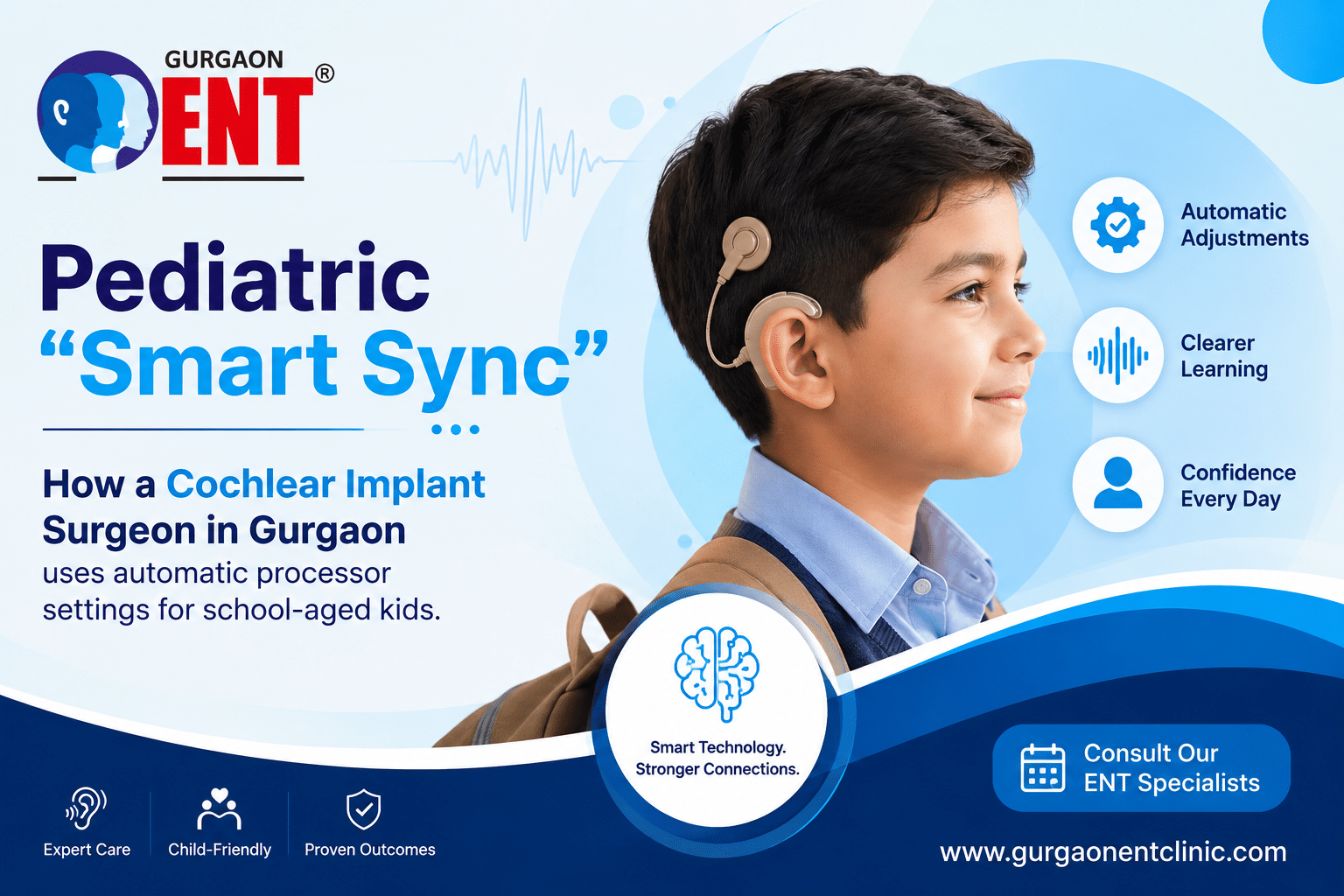
If someone ever noticed, there is an emotional type of worry you can see in a parent’s eyes. It’s not dramatic. It doesn’t wave its arms around. But it’s there, and I see it all the time, maybe because I’ve spent the last fifteen-odd years looking for it. A mother will fidget with her dupatta. A father will clear his throat twice before asking the question they really came to ask. And that question, almost always, boils down to something like this: when my child is at school — in all that noise, all that chaos, all those little moments I’m not there for — will they actually *hear* what matters?
Will she catch the teacher’s voice over the kid tapping a pencil two desks away? Will she understand the joke her friend whispers during lunch, or just smile and nod? Will the playground — wind, shouting, the thud of a football — get so loud and messy that she just pulls the device off her ear and checks out?
I’m a Cochlear Implant Surgeon. That’s my title. But more than anything, I’m the person who has sat across from hundreds of families at Gurgaon ENT Clinic, trying to help them find a path through that worry. The surgery I do is important. But honestly, it’s only one chapter. The part that truly transforms a school day — the thing that lets a kid just be a kid is a lot smaller and, in a strange way, a lot quieter. It lives inside the sound processor they wear behind their ear..
It does something more which is magical even after all this time. It always gets adjusted. Without anyone intervening or pressing a button. I am going to discuss it, without any technical terms or unnecessary jargon of words. Just, how it works in real life. And why our team at Gurgaon ENT Clinic leans so heavily on automatic processor settings for children between about five and twelve. Because if you’re a parent trying to make sense of all this, I think this is the bit that actually matters.
A School Day, Minute by Minute, Through a Child’s Ears
Picture a seven-year-old. Let’s call her Anika. She attends her class around 8:00, it is reading time and the class is quiet, only the teacher’s soft voice can be heard and she can follow everything the teacher is saying without any problem.
Then 9:15 hits. Group discussion time. All of twenty kids are talking together, with chairs moving, lighters can be heard and pencil boxes falling on the floor. The room has hard floors and big windows — nowhere for sound to go except bounce around. If Anika’s sound processor stays in that quiet-reading mode, every voice melts into a wall of noise. She won’t be able to pick out her friend’s sentence from the chaos. She might miss what the teacher says about the project they’re supposed to start. And if this keeps happening day after day, something begins to shift inside her. She starts to tune out. It’s not her fault. It’s self-preservation.
By 10:00 she’s outside for games. Wind rushes past the microphones. Her coach yells something from thirty feet away. Then lunch, in a huge hall where dozens of plates and spoons clatter against steel trays. Then, suddenly, the library — pin-drop silence for half an hour. And later, music class, where sound needs to feel rich and full, not tinny and distant.
These swings happen in seconds. Not minutes. Seconds. In the past, you’d need someone — a teacher, a parent, an older child — to physically press a button on the processor to change the program. In reality, that almost never happened reliably. Kids forgot. Teachers had thirty other kids to manage. So the processor stayed on one all-purpose setting that worked okay in one environment and pretty badly everywhere else. A lot of words got lost. A lot of connections never happened.
What I Really Mean When I Talk About Automatic Settings
Whenever I mention terms like Smart Sync or automatic scene classification to parents, I try to translate it into something that makes sense without a manual. I tell them to imagine a tiny, tireless little friend living inside that processor , one that doesn’t just hear sounds, but actually understands what kind of sound it is.It can detect the difference between a silent room and a crowded cafeteria, or an open field and music. And within minutes, it can detect the sound of exactly what it needs to attract. So what does that feel like for a child? Let’s say Anika is sitting at her desk and the teacher starts explaining a maths problem while another kid is whispering nearby. The processor automatically focuses its “listening beam” toward the teacher, dials down the background mumble, and makes the speech crisp. If a door slams somewhere — that sudden, jarring bang — the system suppresses it so fast Anika barely notices. And if she has implants in both ears, the two processors talk to each other wirelessly, helping her figure out where sounds are coming from. That’s not just about better hearing; it’s about safety. Knowing which direction a car horn or a friend’s shout is coming from when you’re running around outside.
I’ve watched this unfold in our clinic’s waiting area. A small girl, maybe six, was completely absorbed in a toy. Her mother called her name from across the room — a room filled with people talking, phones ringing, a ceiling fan whirring. Before we had these automatic settings dialed in properly, the girl would have stayed lost in her toy. But this time, her head snapped up instantly. Her mother just stared for a second, and then this slow smile spread across her face. I don’t get tired of seeing that.
A Quick Comparison: Old Manual Approach vs. Today’s Automatic Settings
Parents often ask me to explain the difference between relying on manual programs and letting the processor do the work. Here’s how I usually break it down for them.
| What Matters | Manual Programs (Older Way) | Automatic Settings (Smart Sync) |
| Who switches settings? | Parent, teacher, or child | Processor switches on its own within microseconds |
| How fast does it adapt? | Only when someone notices a problem | Almost instantly as the environment changes |
| Real-world consistency | Poor — settings often left in one mode all day | Excellent — follows the child through every activity |
| Hearing in noise | Needs the right program to be selected manually | Automatically activates directional mics and noise reduction |
| Binaural coordination | Limited or none | Two processors sync wirelessly for localization |
| Wearing time | Often lower because of discomfort or poor sound quality | Higher because the listening experience is more comfortable |
| Useful data for the team | Minimal | Detailed environment logs guide smarter mapping |
How We Actually Do Things at Gurgaon ENT Clinic
I want to walk you through the journey we take with families here. It’s not a fast-food kind of process. It never has been. It’s more like a slow, careful conversation that extends over months, and honestly, years.
The First Conversation: We Talk About Your Kid, Not Just Their Audiogram
When a parent first sits down across from me, I’m not reaching for a glossy brochure. I want to know about their child’s day. What do they love doing once school lets out? Are they the barefoot-outside type, or more of a curl-up-with-a-book type? Is their classroom small and quiet, or big and boomy? Do they seem drawn to music, or do sudden loud sounds upset them? All of this stuff matters because it tells me which implant platform — and which flavour of “automatic” — is actually going to fit into their real life, not just a spec sheet. I bring out comparison charts and explain what each brand’s automatic system does, but I’m upfront about it: there’s no one perfect device. There’s just the one that lines up with *your* child’s world.
Surgery That Lays the Groundwork
The operation itself, I keep as gentle as I possibly can. I use minimally invasive techniques, real-time nerve monitoring the whole time, and I’m meticulous about placing that electrode array exactly where it needs to be — covering the full length of the cochlea, if anatomy allows. Why does surgical precision matter for automatic settings? Because the smarter the processor’s software, the more it relies on a clean, complete signal from the inner ear. If the electrode is poorly placed, the signal is a bit muddy. No algorithm can fully clean that up. So the surgery and the tech, they’re not separate things. They’re partners.
Activation and the Gentle Start
About two to four weeks after surgery, we put the external processor on for the first time. I try to be in the room for that. It’s not required, I just… those moments are something else. From day one, our audiology team switches on the automatic scene classifier, but we don’t let it run wild. We start it off slow. The brain hasn’t learned to interpret these new electrical signals yet, and we don’t want to overwhelm it. Over the next few months, we gradually widen the range of automatic adaptation, letting it become bolder as the child’s comfort grows. This slow-and-steady path makes a big difference compared to throwing everything at them on day one.
The “School Readiness” Tune-Up
Then comes the session I genuinely look forward to. About three to six months in, once the child is responding consistently, we schedule a mapping appointment that’s all about school. We set up our audiology room to feel like a mini classroom. We play recordings of a teacher’s voice with background babble, we simulate hallway chatter, we add wind noise. I’ll often sit with the parents and just watch the processor glide between modes without anyone touching anything. We tweak things. Maybe we push the noise reduction up a notch for group work. We nearly always pair the processor with a remote microphone the teacher will wear, and we test that the child hears both the streamed teacher voice and the real-life friend asking a question beside them. And then we look at the data logs together — the processor quietly keeps track of wearing hours and sound environments. If we see the child is spending three hours a day in loud, speech-deprived situations, we talk about practical fixes: moving the desk closer, adding a carpet at home, adjusting the sensitivity. It’s this kind of fine-tuning that turns a good outcome into a great one.
A Couple of Stories That Have Stayed With Me
I could throw a lot of numbers at you, but I think stories land better. So here are two.
A mother told me about her eight-year-old daughter’s school assembly. The microphone on stage let out that horrible high-pitched screech — the kind that makes everyone in the room flinch. Before she had automatic settings, that sound would have sent her daughter’s hand flying to rip the processor off, maybe even in tears. This time, the processor’s sudden-loud-noise suppression kicked in faster than a blink. The girl didn’t flinch. She just kept listening. Her mother was sitting at the back, watching, and she told me later, “I didn’t have to run up and help her. She was fine. For the first time, she was just… fine.” That word “fine” held a lot of weight.
Another father described his son on the football field. The boy used to struggle to hear the coach’s yelled instructions — wind, distance, all of it. After we got the wind-noise reduction and bilateral sync working properly, things shifted. He started hearing those instructions clearly, even during a fast break. He began positioning himself better, and the other kids noticed. He wasn’t “the kid with the implant” anymore; he was just a solid player. Confidence can be a quiet thing, but it changes everything.
We track wearing times at the clinic because it’s a simple, honest signal. Kids on these automatic settings average more than 12 hours a day. Before, with the old manual-program approach, the average hovered around 9.5 hours. That’s nearly three extra hours of language and connection every single day. Add that up over a school year, and it’s enormous.
Does the Surgeon Still Matter When the Tech Is This Smart?
I get this question from time to time. It’s a fair one. If the processor does all this clever stuff on its own, why does it matter who put the electrode in? The short answer: it matters a lot.
Those automatic settings work with the raw auditory information the electrode picks up from the cochlea. If the electrode isn’t covering the full length of the cochlea well, or if it’s sitting at a suboptimal angle, the signal is incomplete — a bit like a radio station that’s not quite tuned in. The processor’s software will do its best, but it’s working with a fuzzy picture. No amount of smart programming can fully fix a poor electrode placement. This is why I’m so finicky in the operating room, and why I’ve spent my career doing nothing but ear and skull-base surgery. Over 800 implant surgeries now, many on kids with tricky inner-ear anatomy. That depth of experience translates directly into how clearly a child will hear later, even when the device is doing the day-to-day heavy lifting.
Gurgaon ENT Clinic is a recognised Centre of Excellence for cochlear implantation. I train visiting surgeons, I present our outcomes data at national meetings, and our results are audited. I share this not to wave a flag, but because trust is built on knowing the person as Cochlear Implant Surgeon in Gurgaon fix your child’s future has walked this road many times before.
On Trust, and the Small Things We Try to Get Right
I realise that trusting a surgeon with your child’s hearing is an enormous leap. So we do a few things I hope make it feel less like a blind jump and more like a steady step.
Before any surgery, you get a plain-language document — no medical fog — that explains the whole process, the recovery, what to expect, and any alternatives. You meet our paediatric psychologist. You have the chance to talk, informally, with another family who’s already been through this. No script, no filter. Our address, our privacy policy, our terms — they’re on our website and handed over in writing at the first visit. I figure transparency isn’t a one-time box to tick. It’s the foundation of a relationship that might last for years. I want you to feel you can call us with a small worry and actually be heard.
Frequently Asked Questions
What’s the youngest age for an implant with automatic features?
We can go as early as 9 to 12 months, if the audiology workup says the child is a candidate. The automatic scene classifier gets turned on from day one of activation, but we let it unfold gently. Since babies can’t tell us how it sounds, we watch their behaviour carefully and expand the settings bit by bit.
Can you customise the settings for my child’s particular school?
Yes, very much so. During mapping, we dial in the sensitivity based on the environments you describe — if the assembly hall is especially echoey, or if there’s a daily music class, we build a personalised setup for that. It’s not a generic exercise.
Will my child still need the teacher’s microphone?
In most classrooms, yes. The remote mic delivers the teacher’s voice straight into the processor, cutting through distance and noise. The automatic system then blends that streamed voice with the ambient sounds, so the child doesn’t feel cut off from the class. They hear the teacher crisply *and* the friend who just whispered something funny.
How can I tell if the automatic mode is really working?
We look at the data logs together — you’ll see exact wearing hours and the sound environments. We do formal speech testing in noise, and improvement is measurable. But honestly, most parents notice at home first. Your child might laugh at a remark from the back seat of the car, or tell you what a friend said in the jungle gym. Those little moments add up.
Can they switch to manual if needed?
We keep a manual override available, especially for older kids. But I’ll tell you the truth: in my experience, once the automatic setup is dialled in well, kids almost never reach for it. They just live their day. Which is sort of the whole point.
If You’re Thinking About the Next Step
If something in all of this feels like it might connect with what your family is going through, the best thing you can do is come in for a proper, unhurried evaluation. Not a rushed phone call, not a sales pitch. Just a sit-down where we look at everything together — your child’s hearing tests, the scans, their daily routines, your hopes, your worries. I’ll show you how the automatic processor behaves in real time. You can bring whoever you need. You can ask the same question twice. That’s okay.
Our comprehensive assessment includes paediatric audiology, high-resolution imaging, a realistic conversation about outcomes based on real data from our own clinic’s families, and a chance to trial the technology. We’ll also walk through what life looks like after surgery — the therapy, the school coordination, the long-term mapping schedule. I stay involved. I want to, because I’ve seen the difference continuity makes for these kids.
Recent Post
-

The “Wait-and-Watch” Protocol: When a Thyroid Surgeon in Gurgaon recommends active surveillance.
September 16, 2026
-
Total Middle Ear Restoration: Beyond the Drum, What a Tympanoplasty Surgeon in Gurgaon Can Rebuild
September 9, 2026
-

Globus Sensation: Understanding the “Lump in Throat” Feeling With an ENT Specialist in Gurgaon
September 7, 2026