
So there’s this patient. Rajat. I won’t forget him.He came in on a Tuesday morning, maybe 9:30, straight from the airport. I remember thinking he looked like someone who’d just lost a fight with a vacuum cleaner. One hand pressed flat against his left ear, the other clutching his phone, and on the screen was the search that brought him to me: ENT Doctor near me Gurgaon. He’d landed from Singapore about an hour earlier. Didn’t go home. Didn’t even grab a coffee. Just came straight to the clinic because his ear had locked up during descent and the pain was, in his words, “something else entirely.”
I get a lot of these. Maybe not every day, but enough that I’ve stopped counting. Business flyers mostly. The occasional holidaymaker who spent the whole flight miserable. Sometimes a flight attendant who should know better but still gets caught out. Kids, of course—they scream, parents panic, everyone ends up at an ENT. But Rajat stuck with me because of how he described it. He said it felt like a tight cork had been jammed deep in his ear canal and left there. And he’d tried everything. Gum chewing till his jaw clicked. Yawning so hard his eyes streamed. That nose-pinch-blow maneuver. Nothing. He was exhausted, half-deaf on one side, and genuinely scared something had burst inside his head.
I see that fear a lot. People don’t know ears can do this. They think hearing loss is gradual, age-related, not something that hits you mid-flight. When it happens suddenly, the panic is real. And I get it. Your ear is this tiny, intricate thing you never think about until it stops working right. Then it’s all you can think about.
A Little Anatomy, but Keep It Simple
Here’s what I told Rajat, and what I tell anyone who sits in that chair looking worried. There is a hollow space behind the ear drum. It is the middle ear and it is connected with the back of the nose with a thin tube-like structure called the Eustachian tube. It is the most important part of the ear. Whenever someone takes a yawn or swallow, it opens up and blinks, and lets a puff of air inside, hence keeping the equal pressure in both sides of the ear drum. It is not noticeable by many but it works like that, silently.
Flying messes that up fast. On descent, the cabin pressure outside your ear shoots up. Due to cold, allergies or some external factors, the pressure in the middle ear gets disturbed. A vacuum pulls the ear inside, and that pull hurts. As our body does not like empty spaces, fluids from nearby tissues fill it up. Now with the middle ear being filed up by fluids, eardrums are unable to vibrate properly resulting in hearing sounds like it is coming from under water. In worst case scenario, the eardrum just tears, resulting in blood or clear fluids coming out. It is a cause of caution and an expert doctor should be visited as quickly as possible.
The Cleveland Clinic has a good page on this, airplane ear, barotrauma, same thing. They note it can affect anyone, though kids and people with any nasal congestion are far more likely to get hit. I’ve read their stuff. It lines up with what I see daily.
How I Know What’s Going On Just by Listening
After a while, you learn to read symptoms like a map. Here’s what I listen for when someone describes their ear after a flight.
If it’s just a blocked feeling and some popping when you swallow, that’s the mild end. Give it time. Usually clears on its own.
When there is any real pain, be it sharp or dull sensation, which is created at the time of landing and not going, the ear drum strains abnormally.
When you notice that hearing is sounding like someone is talking from a distance or muffled, or someone put cotton inside the ear, it is certain that fluids are getting deposited behind the drum.
A new ringing or hissing sound? The inner ear might be irritated from the pressure shift. That can be temporary or, sometimes, a bit more stubborn.
Dizziness, the room spinning, feeling like you’re walking on a boat—that tells me the balance parts of the inner ear are involved. I take that seriously.
And if fluid or blood is draining out, that’s a perforation. No question. You need to be seen immediately.
Rajat was in the third category. Fluid had built up, his hearing was shot, and the ache was relentless. He’d waited about two hours after landing before giving up and searching for an ENT Doctor near me Gurgaon. Honestly, that was the right call.
Things You Can Try Before You Call Us
I’m not someone who insists everyone rush to a clinic. For mild cases, a few tricks can do the job. I’ll tell you what I tell my own family.
Try to stay awake when the plane is coming down, it may be impossible as the warmth and light makes someone sleep, but if you sleep you will stop swallowing.
Your Eustachian tubes go offline. That’s how the pressure locks in. So fight the nap. Sip water constantly. Chew gum. Suck on a hard candy. Anything that makes you swallow.
The Valsalva thing—pinch your nose, close your mouth, blow gently—can work. But I mean gently. I’ve had patients blow so hard they tore their eardrum. A safer bet is the Toynbee maneuver: pinch your nose and swallow. Sounds too simple, but it often does the trick.
Pressure-regulating earplugs like EarPlanes help. They slow down the pressure change at the eardrum, giving your tube a little extra time to adapt. I recommend them to frequent flyers.
If you’re flying with a cold or bad allergies, your risk shoots way up. In that case, after checking with a doctor, a decongestant nasal spray used about 30 minutes before landing might help. But don’t just grab one off the shelf. These can spike your blood pressure. Always ask first.
A Quick Table to Help You Decide (Because People Always Ask)
Sometimes you just want a clear answer. I get it. So here’s a table I mentally run through when patients call and ask if they should come in.
| Symptom Severity | What You Can Try at Home | When to See an ENT Doctor near me Gurgaon |
| Mild fullness, some popping | Yawn, swallow, chew gum, gentle Valsalva | If it’s still there after a full day |
| Moderate pain and muffled hearing | Decongestant spray (if safe), equalisation | If no improvement in 48 hours, or pain is increasing |
| Sharp severe pain, dizziness, major hearing loss | Nothing—don’t experiment | Same day, or next morning |
| Fluid or blood draining | No home remedy | Immediately—possible perforation |
Rajat was somewhere between row two and three when he came in. He’d tried everything in row one. It was time.
What Happened When Rajat Sat in My Chair
I had him lean back. Used the oto-endoscope—tiny camera, no pain at all—to look at his eardrum. On the screen, I could see the fluid behind it, the way the drum was retracted and angry-looking. Tympanometry confirmed it. Flat line. His eardrum wasn’t moving at all. It was locked tight.
For fluid that’s minor, I’d just give a nasal spray, maybe an anti-inflammatory, and tell you to come back if it doesn’t clear. But Rajat’s was significant. He was struggling to hear. He was in pain. So I suggested a myringotomy. It sounds scarier than it is. We numb the eardrum with drops. Then I make a tiny slit—smaller than a pinprick—to let the fluid drain. The relief is instant. His hearing opened up right there, and the pain just melted away. He actually laughed. Relief does that to people.
The little hole heals on its own in a few days. No stitches. No fuss. We follow treatment standards from the Indian Academy of Otorhinolaryngology and Head & Neck Surgery. And I don’t push procedures. If medication and time will fix it, I’ll say so. I only reach for instruments when it’s genuinely needed.
A Note for People Who Fly All the Time
If your ears do this every trip, let’s sit down before your next flight and figure out why. I’ll scope your nose—quick, not painful—and check for hidden allergies, a deviated septum, sinus issues. These are the things that quietly sabotage your Eustachian tube. Once we know, we can build a plan. Maybe a steroid spray a few days before travel. Maybe the right way to use EarPlanes. For the rare case where the tube is just permanently narrow, balloon dilation is an option, but that’s a big conversation, not a quick decision. I never rush it.
Frequently Asked Questions
Is this dangerous?
Usually no. But a ruptured eardrum or inner ear damage can leave lasting issues. And old trapped fluid can get infected. So don’t ignore it.
Can I fly with a cold?
I’d rather you didn’t. But if you must, see an ENT Doctor near me Gurgaon first. There are ways to reduce the risk, but you need a tailored plan.
How long is too long to wait?
After 48 hours of no improvement, I worry. A week is too long. Book an appointment.
Will draining it hurt?
We numb the drum. You feel pressure, not pain. And the moment it drains, you’ll wonder why you waited.
Can’t a GP handle it?
A GP can check for outer ear infections. But they don’t have the scope or the tympanometry gear. For proper barotrauma, a specialist is faster and more accurate.
The End of Rajat’s Story, and Maybe Yours
Rajat walked out of the clinic about an hour after he arrived. Hearing clearly. Pain gone. He said he was finally going home to hug his kids and take a nap. Not a bad outcome for a morning that started in panic at the airport.
If your ear is still blocked after a flight, or the ache won’t ease, or you’re tired of saying “what?” every time someone speaks, just come in. At Gurgaon ENT Clinic, we’ll sort out what’s happening without any fuss. Plain words, no overselling, just proper care. You can book through [https://gurgaonentclinic.com/ or call the clinic. Your ears put up with a lot. They deserve some attention.
Written by: Gurgaon ENT Clinic Team
Gurgaon ENT Clinic, spearheaded by Dr Ravinder Gera, with 22+ years of experience and 300+ ENT surgeries is revolutionizing the ENT treatment in Gurgaon since 2004.
Published:
*Disclaimer: This is based on real clinical experience, but it’s not a substitute for a personal exam. Every ear is different. Get yours checked properly before deciding on treatment.*
Recent Post
-

The “Wait-and-Watch” Protocol: When a Thyroid Surgeon in Gurgaon recommends active surveillance.
September 16, 2026
-
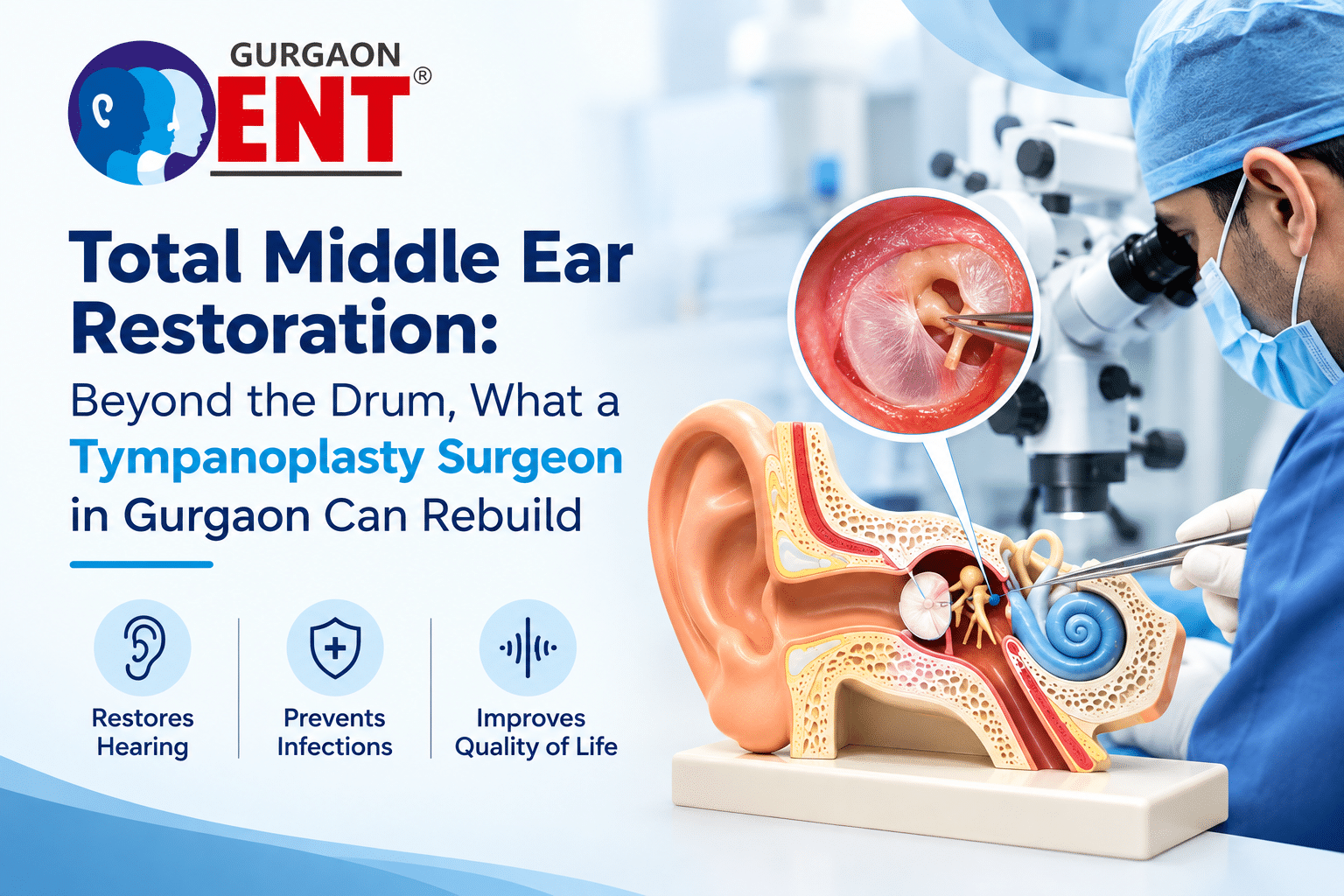
Total Middle Ear Restoration: Beyond the Drum, What a Tympanoplasty Surgeon in Gurgaon Can Rebuild
September 9, 2026
-

Globus Sensation: Understanding the “Lump in Throat” Feeling With an ENT Specialist in Gurgaon
September 7, 2026