
I have been doing this ENT thing for over twenty years now. Started my practice back when we were still developing film X-rays in a dark room and hoping they came out right. Seen a lot of change. It is a dull and continuous sensation of weight which has a feeling like someone stuffed her head with wet papers. But some things? They never really do. Like the look on a patient’s face when they realize they have been fighting the wrong battle for months on end.
There was this one woman. She is in her thirties, working in the finance sector with a sharp, professional mind. The type of a person who we can say is successful. Came in wearing this really nice blazer, but you could tell she had not slept properly in ages. And she had not. That pressure under her eye kept her up at night. Not a sharp pain, nothing dramatic.
She confirmed that she has done everything right. Saw her GP twice. Tried the steroid sprays. Did the neti pot thing religiously, every single morning and night. Even cut out dairy for three weeks because a colleague at work swore it helped her allergies. Nothing touched it.
Antibiotics gave some needed relief , but it was temporary, it came back every time, and she was at her end of the patience.
And honestly? We could not blame her. As we began asking about her dental history, she blinked in surprise. Said she had a root canal on an upper molar about eight years ago. No issues since. No pain, no sensitivity. She can’t even memorise which side it was. But something she said made the Sinus Surgeon in Gurgaon go deeper about the problem.
Here is what most folks do not realize
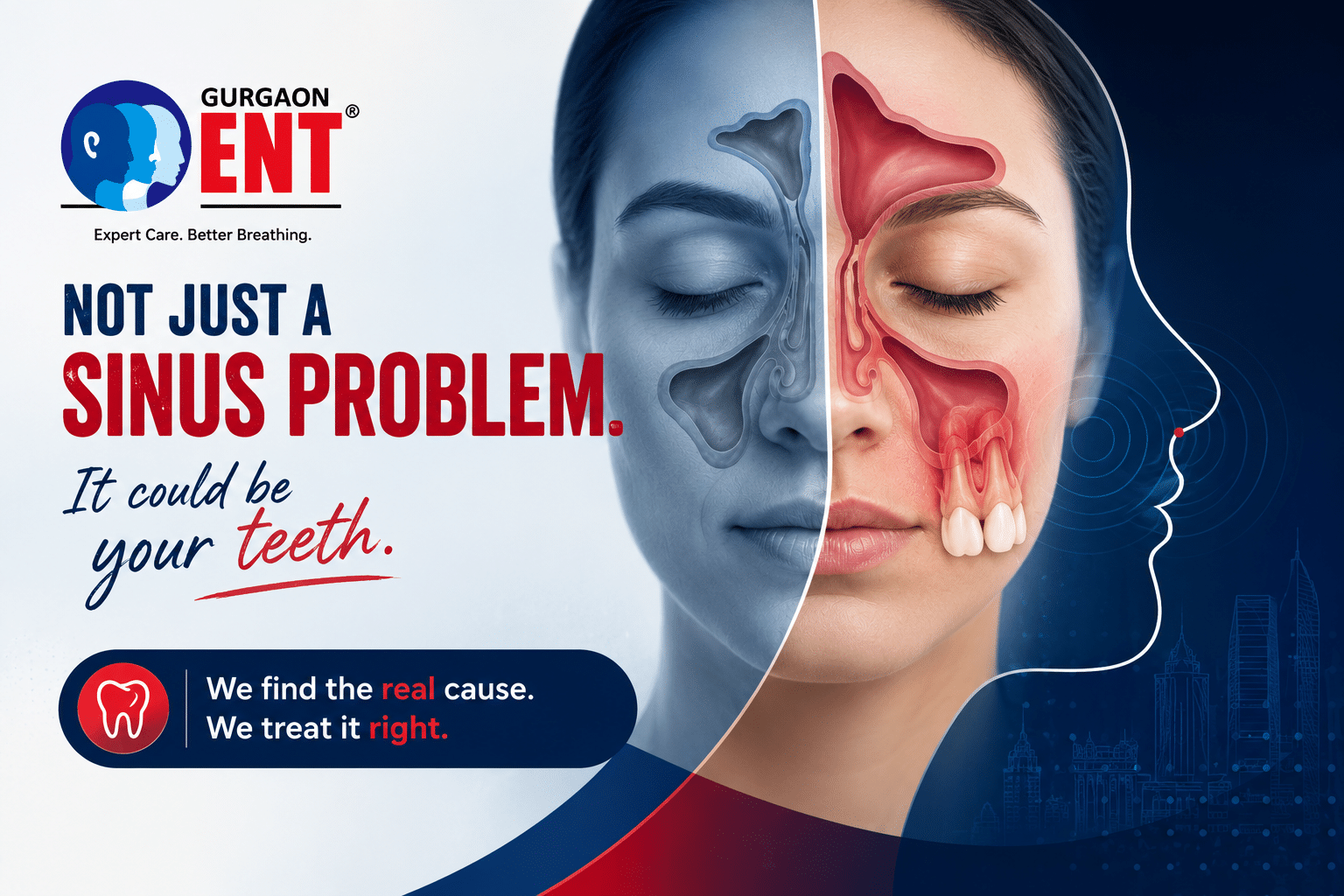
Your upper back teeth, those premolars and molars, sit right up against the floor of your maxillary sinuses. In some people, that bone separating them is barely there. Maybe a few millimeters maximum. When an infection affects the tooth, it may be in a crack which was unnoticed, the affected area can be old root canal gone wrong, the bacteria don’t need to travel far to spread rapidly. They eat through that thin bone and spill right into your sinus cavity.
And the whole time, your tooth might not hurt at all. The nerve could be long dead. You could go years with no clue that anything is wrong down there, while your sinuses slowly get wrecked.
That is exactly what happened with her. Her old root canal had developed a tiny abscess at the tip. Completely silent. I have seen this a hundred times. Sinus at that side is a big problem, linings are thick , the drainage pathway is totally blocked and there is a sense of smell which cannot be removed after numerous brushing or using mouthwash. Classic odontogenic sinusitis. Textbooks could not have drawn it up better.
Why your medications are letting you down
You know what drives me up the wall? Seeing patients come in who have been through three or four different antibiotics, convinced they have some kind of resistant superbug. I get why they think that. But that is rarely the case.
The bacteria hiding in that dead tooth root are protected. There is something formed known as biofilm, it is more like a bacterial fortress. Antibiotics consumed spread in the bloodstream and reach the linen of the sinus easily. It helps in reducing the inflammation and temporarily makes you feel better. But they cannot penetrate that biofilm. The bugs just hunker down and wait it out. So you go through this miserable cycle, feel a bit better for a week or two. Stop the meds. Infection flares back up. Rinse and repeat.
It is frustrating. It is expensive. And honestly? It is completely unnecessary if someone just thinks to check your teeth. I read somewhere that odontogenic sinusitis accounts for anywhere from ten to forty percent of all chronic maxillary sinusitis cases. That is a huge number of people suffering needlessly. Most general practitioners simply do not think to look for the dental connection. They treat what they see, and what they see is a sinus infection.
How we finally figure it out
Getting to the bottom of this takes a specific approach. A standard sinus CT will show you the cloudiness, sure. But it often misses the subtle details at the root tip. That is why we use Cone Beam CT imaging. It gives us a three-dimensional view of both the teeth and the sinuses together. We can see exactly where the bone has been breached and pinpoint the offending tooth.
There was some interesting research that came out just a few months ago. A group developed an AI model that can detect this condition from regular dental X-rays with over ninety-eight percent accuracy. Pretty remarkable stuff. You can read about it [here](https://www.news-medical.net/news/20250331/AI-model-achieves-high-accuracy-in-detecting-odontogenic-sinusitis-in-dental-X-rays.aspx ) if you are interested.
But even with all that fancy technology, the real work is still about listening. About connecting the dots that other people missed.
The fix is not as simple as you might think
Here is where people often get the wrong advice. Some dentists will tell you to just pull the tooth and be done with it. Some ENTs will scope the sinus and ignore the dental problem entirely. Both approaches are incomplete.
You cannot just extract the tooth and hope the sinus heals on its own. It has been inflamed for months. The lining is thickened. The drainage pathways are blocked. It needs surgical help to clear out all that inflammatory gunk.
And you cannot just scope the sinus while leaving that infected root in place. The bacteria will keep pumping out infection, and you will be right back where you started in a few months.Both problems need to be addressed at the same time. That takes collaboration.
At our clinic, we work directly with oral surgeons to plan a single procedure. While they handle the dental side—extraction, root revision, whatever is needed—we step in with endoscopic sinus surgery. We open up the blocked passages, clear out all the infected material, and create proper drainage so the sinus can finally heal.
There is solid research backing this approach. A study published earlier this year showed that patients who had combined surgery were far less likely to need a second operation. It just makes sense. You are solving the whole problem in one go.
The moment it all clicks
She came back for her follow-up about two weeks after her surgery. I remember she was wearing this bright red kurti, which was a change from the tired neutral tones she had been wearing before. She walked in with actual energy. Smiling.
When I asked how she was feeling, she took this long, slow breath through her nose. Her eyes got a little wide. She said she had not been able to do that in almost a year.
It is moments like that that keep me going. The relief on her face. The way she laughed about how ridiculous it was that the problem was hiding in a tooth she had forgotten about years ago.
That is the part people do not see. The months of frustration. The sleepless nights. The quiet desperation when nothing seems to work. And then the sudden, almost overwhelming relief when someone finally figures it out.
What I really want you to understand
If you are stuck in that cycle. If your sinus infection will not go away, especially if it is stubbornly on one side. If you have a bad taste in your mouth that will not quit. If you have had any dental work on your upper molars in the past. Those are not random symptoms. They are clues.
The connection between your teeth and your sinuses is very real. And it is far more common than people realize. The fix requires someone who understands both sides of that equation. A skilled Sinus Surgeon in Gurgaon who looks at the whole picture. Who does not just treat the nose or just treat the teeth. Who connects the dots and solves the actual problem.
Do not spend another month chasing symptoms. Get the right imaging. Get the right diagnosis. Get the relief you deserve. Life is too short to be stuck holding your breath.